business growth · engineered

I grow businesses like an engineer.

Find the constraint. Fix it. Automate it. I work inside your business and build in the tools you already use. 22 years in engineering, from mechanical designer to Manager of Engineering for a 70-person department. Two e-commerce brands built and run since 2014. AI is my current best tool — it replaced $75K+ a year of agency work in my own businesses before I ever built a system for a client.

Based in Oakville, Ontario — serving the GTA and beyond

GK
Greg Kowalczyk - Business Growth Engineer in Oakville, Ontario
Proof of work

Drawn. Built. Shipped.

Eight products I designed, built and run. Each one started as a constraint somebody lived with every day. Watch each blueprint build itself into the real thing.

Proof of work
01 / 08
01 · Amazon seller intelligence

Helm

The constraint

Answering "why did ACOS jump last week?" took an afternoon of spreadsheets.

What I built

One place for Amazon, Ads, Shopify, Meta, Klaviyo and Search Console data, handed to Claude as tools. Now the answer takes one sentence.

33tools for sales, ads, stock and margin
6data sources in one place
0writes. It reads, never changes a bid
How Helm works → In testing
02 · Mercedes-Benz Oakville · the race I direct

Bronte Harbour Classic

The constraint

A brand-new race with no history had to sell out registrations, win sponsors and look established from day one.

What I built

I am the Race Director, and I built everything online: registration, course maps, sponsor pages, and a permanent archive. The QR code on every finisher medal opens it.

875runners, sold out in year one
1,800+race photos archived
3 racesin 2027: 5K, 10K and Kids 1K
03 · Community running club website

Bronte Runners

The constraint

A free club with 800+ members needed one place for this week’s runs, the routes, events and photos.

What I built

The club website: a live countdown to the next run, mapped routes, events, news, photo albums, team and partner pages. Volunteers update it by editing simple files.

800+members in Oakville and Burlington
1 dayto build and ship it
3group runs a week, year-round
04 · National clinic directory

SportClinicFinder

The constraint

Patients had no single place to compare physio, chiro and sports medicine clinics across Canada.

What I built

A Canada-wide directory with insurance details, Google ratings and booking links. Clinics can claim and update their own listing.

12,777clinics listed
519cities, every province
245+search landing pages
05 · Regional health directory

SleepClinicFinder

The constraint

Sleep patients in Peel, Halton and the GTA could not tell which clinics bill OHIP, need a referral or offer home tests.

What I built

An evidence-first directory. Every claim on a clinic profile is quoted from that clinic’s own website.

221sleep clinics
< 1 wkfrom idea to live
10patient guides
06 · iOS app

SunUp by GearTOP

The constraint

A UV index number does not tell you when you will actually burn.

What I built

An app that turns skin type, live UV and cloud cover into one number: minutes to burn. Family mode gives every child a profile.

FreeiOS app, no ads
230+built-in sun safety tips
1number that matters: minutes to burn
07 · iOS app

RunMate Pro

The constraint

Runners do not notice their shoes wearing out until the shin splints start.

What I built

GPS run tracking that logs every run against a pair of shoes and warns before a pair is worn out. No feed, no leaderboards.

39App Store rejections, all fixed
2025live on the App Store
500–800km shoe lifespan it tracks
08 · Team research library

Magpie

The constraint

Research kept getting done twice by different people on the team.

What I built

Drop in a link, screenshot or quote. Magpie titles, summarizes and files it, and AI agents can search it too.

2 sto capture, no form
AItitles, summaries, categories
APIso agents read and write
Hover the blueprint to x-ray it
Project 1 of 8
X-ray
See all 8 with the full scroll story → Draw your own blueprint ↓
Your turn

Draw your blueprint.

Three taps. I will sketch the system I would build for your business, and show you where I have already built one like it.

1Your business
2Where you lose the most time
3Tools you already use · pick any
Your system blueprint

For your studio: a decision dashboard with an AI analyst that works with the tools you already use.

Book a free 15-minute call →
How it works

From blueprint to a system you own.

Four steps. Watch what happens to the work at each one. See the full method →

  1. 01
    Free 15-minute assessmentNo cost

    Map the work

    Every business has one place where work piles up. On a short call we find yours. I name the tool that fixes it and give you a first step you can take without me.

    • One bottleneck, examined properly
    • One tool named, with what it costs
    • One first step you can take yourself
    Book the free 15 minutes →
  2. 02
    The AI Assessment$1,000, credited against a build

    Sort every step

    I watch how the work really happens and write down every step. Then I sort each one: delete it, hand it to plain code, hand it to an AI agent, or keep it with a person. You get a written build plan with real tools and real costs.

    • Every step sorted, and ranked by what it costs you
    • A written plan with tools and costs
    • Yours to keep, whether or not I build it
    Start with the assessment →
  3. 03
    Fixed-price buildYou own everything

    Build inside your tools

    I connect the tools you already use, add AI where reading and writing eat your time, and add checks so you approve what matters. I write the code and deploy it.

    • Works inside the tools you already use
    • Approvals arrive by email or Slack
    • No licence, no lock-in
  4. 04
    Handover or monthlyTraining included, always

    Prove it, then hand it over

    Before I build, we write down today’s numbers. At 30 and 90 days I measure again, against the same numbers. I document the system and train your team to run it without me, or stay on monthly for the next constraint.

    • Measured before and after
    • Documentation and training included
    • Then on to the next constraint
    Talk about a build →
How the work flows through your business Work items arrive from your tools. By hand, they queue at one person. After the build, they flow through connect, AI, check and approve steps to finished outputs, and you get a daily brief. SCHEMATIC · WHERE YOUR WORK GOES STAGE 01 / 04 · MAP THE WORK WORK COMES IN FROM Orders Emails Bookings Spreadsheets THE CONSTRAINT 0 WAITING BY HAND You, one item at a time. YOUR SYSTEM Built around your tools CONNECT AI CHECK APPROVE You stay in control Connects to the tools you already use. Runs on your accounts. You own the code. DONE 0 / MIN Replies sent Reports ready Records saved #1 · COSTS THE MOST #2 #3 BUILD PLAN · YOURS TO KEEP Tools to connect, and what they costWhere AI reads and writesFixed price and timeline Daily brief Docs + training · your team runs it NEXT CONSTRAINT = real work coming in: orders, emails, bookings
Every business has one place where work piles up. On a short call we find yours. I name the tool that fixes it and give you a first step you can take without me.
Step 02, up close

Every step goes in one of four places. In this order.

Most people start with AI. I start by deleting. Many steps never need AI at all.

  1. 01

    Delete it

    Some steps exist only because an earlier step went wrong. Fix the cause and the step is gone.

    For exampleChasing a missing detail. Typing the same order twice. Checking the same thing a second time.

  2. 02

    Give it to plain code

    If the rule is “when this happens, do that”, it needs no AI. Code is cheaper and never guesses.

    For exampleOrder paid, send the invoice. New booking, add it to the calendar.

  3. 03

    Give it to an AI agent

    Where the work takes reading and judgement, an agent prepares it. Then it stops and asks.

    For exampleRead the email, pull out the details, draft the reply for you to approve.

  4. 04

    Keep it with a person

    Anything you cannot afford to get wrong stays with you or your team.

    For exampleApproving a refund. Sending money. Signing a quote. Talking to the client.

See the full method, step by step →

For race directors and event organizers

Everything your race needs, off your plate.

I'm the Race Director of the Mercedes-Benz Oakville Bronte Harbour Classic — sold out in year one, run by a small team with AI doing the work of an agency. I build the same system for your race. Follow the runner:

  1. Fill the start line Registration and a race website that people find, trust and sign up from. 875 runners — sold out in year one
  2. Win sponsors, and keep them Every sponsor and vendor gets a permanent page they are proud to share — not a logo on a banner that comes down Sunday. 80 permanent partner pages
  3. Get the word out Race updates turn into articles and social posts, so the race stays in front of people all year. 50+ articles and counting
  4. Emails runners actually read Drafted from your template and sent only when you approve — plus a personal “your photos are ready” note to every runner. Nothing sends without your OK
  5. Keep every runner safe Water stations, start times and sun safety planned and shared before race day, not buried in fine print. One safety plan for 875 runners
  6. Give them a reason to stay — and come back Free race photos found by bib number, a festival after the finish, and a medal whose QR code opens the race archive. 1,843 photos · 92% of bibs found by AI

Runners don't sign up for a banana and a medal. They come for the day — the festival, the photos, the people. The system gives them reasons to stay, and to come back next year.

Festivals, charity walks and tournaments have the same shape. The same system fits.

$0K+ Agency Costs Replaced
0+ Years in E-Commerce
0 iOS Apps Shipped
0+ Pages Per Client
0 Weeks Typical Delivery
FREE MEETUPS

AI for Business: practical AI for local business owners

How the meetups work →
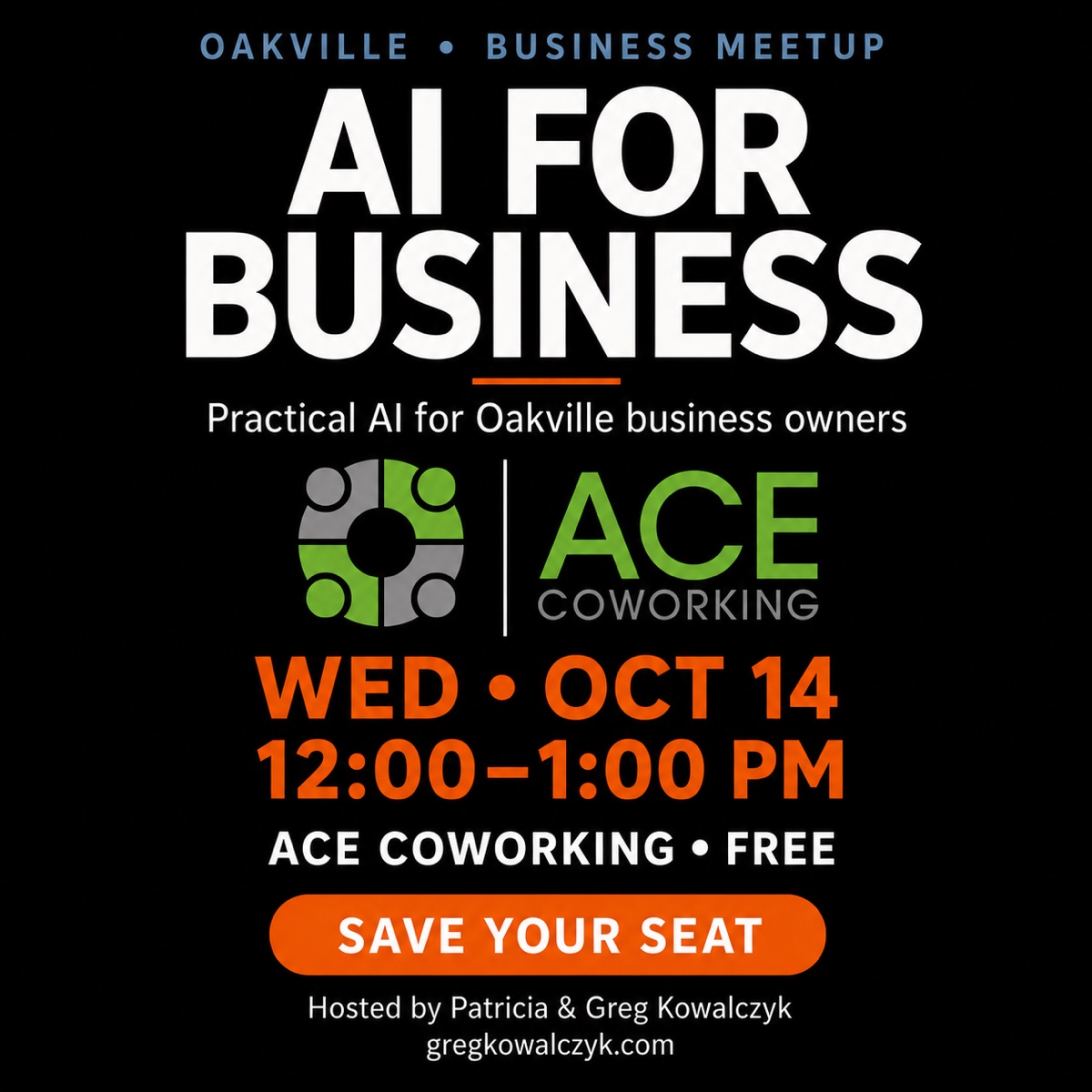
AI for Business Oakville business meetup — Wednesday October 14, 12:00 to 1:00 PM at ACE Coworking, free to attend

Oakville · lunch hour

· 12:00 – 1:00 PM

Practical AI Workflows for Small Business — Save Time, Improve Margins, Get More Done

ACE Coworking, Oakville. Free to attend.

Save your seat →
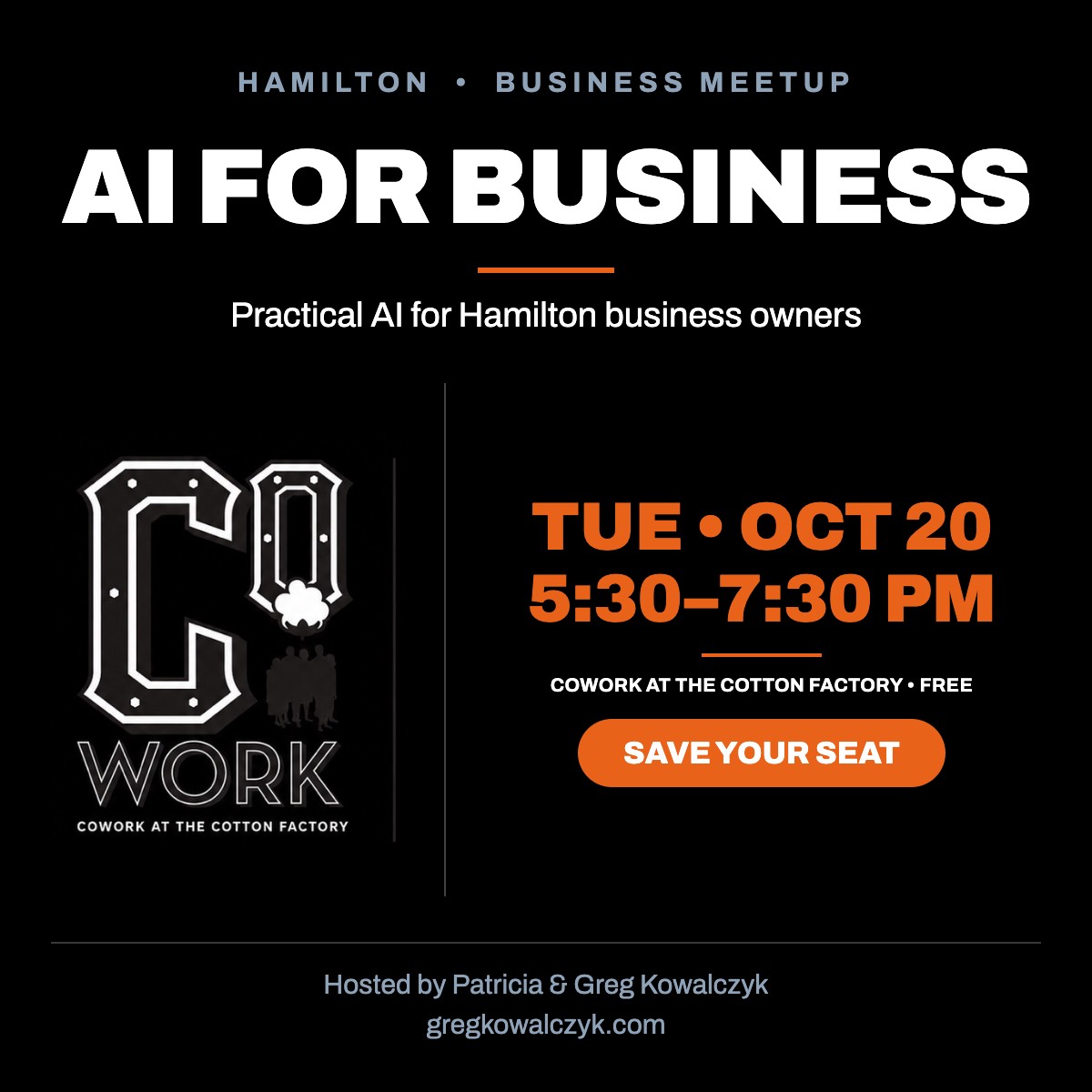
AI for Business Hamilton business meetup — Tuesday October 20, 5:30 to 7:30 PM at CoWork at the Cotton Factory, free to attend

Hamilton · evening

· 5:30 – 7:30 PM

Going Deeper: New AI Features, Live Workflows, and Tips You Can Apply the Next Morning

CoWork at the Cotton Factory, Hamilton. Free to attend.

Save your seat →
Proof, not promises

Before and after.

Three real jobs. On the left, how it was. On the right, what changed.

Client project

Traditional retail shop to full e-commerce operation

BeforeOne shop, one door

New owner, 84+ hours a week, zero e-commerce experience

AfterSelling online, to companies, at better prices

A complete digital operation, delivered in 6 weeks

delivery time
6 weeks
added from pricing alone
Six figures
corporate gifting, built from zero
New channel
revenue trajectory
~2×
Read the full story

New owner, one week into a long-established specialty retail business. Zero e-commerce experience. Working 84+ hours a week. Needed a complete digital transformation plan — fast.

What I built

  • 18 deliverable areas — competitive analysis, pricing strategy, SEO, email, social, UGC, partnerships, financial tracking
  • Custom Content Creator PRO v5.3 — web app for generating platform-specific AI prompts, handed over running
  • Corporate gifting program with B2B sales materials — a six-figure channel that didn’t exist before
  • Pricing optimization strategy — a six-figure annual gain from margin adjustments alone
  • Interactive client dashboard deployed on GitHub Pages — live, browser-based, no downloads
Built without waiting

It used to take days. Now I do it from my phone.

BeforeOne small change took all week

Every change: brief a developer, wait days, review, wait again

AfterNow it takes minutes, from a phone

Minutes: live before the conversation is over

to ship a change, not days
Minutes
apps live in the App Store
2
projects shipped
12
annual agency cost removed
$75K+
Read the full story

Every change used to mean going to a developer. A blog post, a price update, a page that needed fixing — write the brief, wait, review it, wait again. Days, every time, for work that took minutes to describe. And nothing shipped while you waited.

That’s the part that changed. I make the change myself now, often from my phone, and it’s live before the conversation is over. Not because I became a programmer — I’m a mechanical engineer and I’ve never written software professionally. Because describing the work precisely is now enough to get it built.

This is the same capability I hand over. When a client wants a page changed, a post published, or a price updated, the answer stops being “I’ll ask the developer and get back to you next week.”

What’s been shipped that way

  • Two iOS apps, live in the App Store — SunUp, which calculates real burn time from skin type and live UV, and RunMate Pro, GPS tracking with shoe-mileage management. RunMate was rejected 39 times before it was approved.
  • Helm — seller intelligence that pulls Amazon SP-API, Amazon Ads, Shopify, Meta, Klaviyo and Search Console into one place, then exposes it to Claude as tools.
  • A full event platform for a chip-timed road race I direct — 875 runners in its first year, plus their families, spectators and 80 local partners.
  • Two Shopify stores running on API connections, with product content and blog production automated end to end.
  • SportsClinicFinder — a Canada-wide clinic directory covering every province and territory, searchable by city, injury, and specialty.
  • Magpie — a shared research brain for the team, so nobody researches the same thing twice.
  • Marketing sites for both apps, plus this one — statically built, deployed on Vercel, with a post-build audit that fails the deploy on a dead link or a broken image.
  • Content Creator PRO — built for a client, handed over running, so they stopped needing an agency on retainer to do it.
My businesses

Two e-commerce brands running on AI tools I built myself

BeforeMoney out the door every month

$75K–$125K a year to agencies, freelancers and services

AfterThe money stays; the content multiplies

Systems I built, running every day

annual savings
$75K+
content volume
5–10×
email marketing ROI
15–20×
apps live in the App Store
2
Read the full story

Two e-commerce brands. $2M+ in ad spend. Paying $75K-$125K annually for agencies, freelancers, and services. Needed to cut costs without cutting results.

What I built

  • Custom AI content generation systems (100+ product descriptions, brand voice maintained)
  • Marketing automation workflows replacing manual email, social, and ad management
  • 2 iOS apps (SunUp by GearTOP, RunMate Pro) — built as a non-coder using AI tools
  • Analytics dashboards aggregating data from Shopify, Amazon, Google, Meta
  • Operational automation (inventory alerts, reorder triggers, journey orchestration)

// About Greg

Mechanical engineer. 14 years at SMS-Siemag (prior PRO-ECO LTD): mechanical designer, then Manager of Engineering for a 70-person department from 2007 to 2011. Then independent consulting. Then e-commerce — two brands built from scratch since 2014.

In 2024 I went all-in on AI. Built custom tools that replaced $75K+ in agency costs. Shipped two iOS apps as a non-coder. Now I build AI systems for businesses that want working solutions — not strategy decks.

Who this is for

If the same task lands on someone's desk every week, it probably shouldn't.

Every business has a handful of jobs that repeat — quoting, scheduling, chasing, reporting, answering the same question for the hundredth time. They're too small to hire for and too constant to ignore, so they get absorbed by whoever has capacity. Usually the owner.

That work is now automatable, and it doesn't much matter what industry you're in — a pottery studio chasing class bookings and a distributor chasing purchase orders are the same problem wearing different clothes. What matters is whether someone will actually build the thing, deploy it, and stay until your team can run it.

I'm based in Oakville and work across the GTA and Ontario, plus remotely. The proof isn't a slide deck — it's the ecosystem I build in public: two e-commerce brands, two iOS apps in the App Store, a race that sold out at 875 runners, and a directory at local-search scale. Client work runs on the same playbook.

Looking for AI consulting in Oakville?

Start with the task, not the tool. I help Oakville and GTA businesses find the repeat work that is slowing the owner or team down, then build the AI workflow, automation, or internal tool that removes it.

Good fits are quoting, intake, product content, reporting, research, customer follow-up, launch workflows, and internal search. Bad fits are vague AI strategy projects where nobody owns the finished system.

What that's looked like

Pottery studio

Class booking, waitlists, and the follow-up nobody had time to send

Race organization

Registration, sponsor pages, and a permanent searchable photo archive

For race directors →

Fitness studio

Member onboarding and retention sequences that run unattended

Specialty food retailer

Retail shop to full e-commerce operation in six weeks

E-commerce brands

Two of my own, since 2014 — where everything gets tested first

Pharma consultancy

Research and reporting workflows that used to be manual

Six businesses that look nothing like each other. The underlying work was nearly identical.

// Common Questions

Custom AI tool development typically runs $5,000-$25,000 depending on complexity and scope. Compare that to $75,000+ per year for agency retainers delivering similar capabilities. Most of my projects deliver ROI within the first quarter. I scope every project with a clear budget before writing a line of code.

Most projects deliver working systems in 2-8 weeks. A recent client project — 100+ pages of strategy plus a custom AI tool — shipped in 6 weeks. Simple automation workflows can be live in days. I don't do 6-month timelines. You get working software fast, then we iterate based on real data.

The biggest risk is doing nothing while competitors adopt AI tools that cut their costs and speed up their operations. Implementation risks are manageable: I test everything on my own businesses before recommending it, build incrementally so you see results early, and train your team so you're never dependent on me. You own everything I build.

Look for someone who builds, not just advises. Ask to see working tools they've deployed, not just strategy documents they've written. Check if they have skin in the game — do they use AI in their own business? I run two e-commerce brands on AI tools I built myself. That's the difference between theory and practice.

It's a practical evaluation of where AI and automation will generate the highest return in your specific business. I look at your operations, identify repetitive manual work, assess your existing tech stack, and prioritize implementation by ROI. Not a generic checklist — a targeted plan with specific tools and timelines. Then I build it.

Track what matters: time saved, costs reduced, revenue generated. For my own brands, the math is simple — $75K-$125K in annual agency costs replaced by $2K in AI tools. For clients, I set measurable benchmarks before building anything. If we can't quantify the return, we don't build it.

It depends on your biggest pain point. For content generation: Claude + custom prompt systems. For email automation: Klaviyo with AI-driven segmentation. For ad optimization: AI-assisted bid management across Google, Amazon, and Meta. For operations: custom automation workflows connecting Shopify, Amazon, and your fulfillment systems. I've built and tested all of these on my own e-commerce brands.

Not entirely — but it can replace the $75K-$125K in repetitive work you're paying agencies to do manually. Content generation, email sequences, social media scheduling, reporting, ad copy testing — all of this can be automated with custom AI tools. You still need strategic thinking. But you don't need to pay agency rates for execution work that AI handles better and faster.

Yes — and this is where real experience beats theory. I've built two product brands from zero to multi-platform e-commerce since 2014. I know exactly what breaks when you first launch on Amazon, why Shopify stores don't convert out of the box, and how to avoid the expensive mistakes most businesses make trying to figure it out alone. I coach you through the setup and build the AI tools that make it scale.

Yes. Electricians, landscapers, plumbers, HVAC — any local service business that's invisible online. I build your digital foundation: professional website, Google Business Profile, and local SEO. Then I optimize it for LLM search so AI assistants recommend you when people search for your services. The next generation finds local businesses by asking Siri, ChatGPT, and Google. I make sure you show up in all of them.

Platform fees are low — Shopify starts at $39/month, Amazon at $39.99/month. The real investment is the setup: getting listings right, content optimized, and systems in place so you don't waste money on ads before the foundation is solid. My coaching engagements typically run $3,000–$8,000 for the initial setup phase. After that you're running independently with AI tools I've built for you.

An engineer who works inside your business instead of handing you a report. I watch how the work really runs, write down every step, and build the fix inside the tools you already use. Then I measure it against the numbers we wrote down first. It is how I have worked since my engineering years: on the floor, not in a meeting room.

Usually not. I build inside the tools you already use, such as your inbox, your accounting system, your store or your booking system. Your team keeps working where they work today. When a decision needs a person, it arrives as an email or a Slack message with a clear yes or no.

The work changes, the decisions stay with people. When I sort a process, the first steps to go are the ones nobody wanted: chasing, re-typing and doing the same check twice. Many of those are deleted or handled by plain rules, with no AI at all. Approvals, signatures, payments and client conversations stay with your team.

// Writing

Practical posts on AI tools, automation, and building things that actually work.

Ready to Build Something?

Tell me what's eating your time or budget. I'll tell you if AI or automation can fix it — and exactly how I'd build the solution.

Book a call