Forward Deployed Engineer (FDE) and Fractional Chief AI Officer in the GTA: 2027 Guide
What a forward deployed engineer and a fractional Chief AI Officer do for small and medium-sized businesses in Toronto and the GTA in 2027.
The short answer: a forward deployed engineer (FDE) comes into your company, learns how the work really runs, and builds automations and AI systems inside the tools you already use. A fractional Chief AI Officer (CAIO) leads your AI work part-time: where it pays off, which tools to use, how your data stays secure, and what each system saves. In a small or medium-sized business, one experienced person can do both, so your team spends its time on the most valuable work and the routine runs itself.
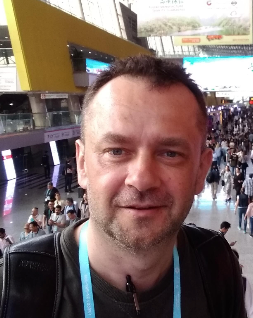
I am Greg Kowalczyk, a forward deployed engineer and fractional Chief AI Officer based in Oakville, Ontario, working with businesses across Toronto and the GTA. This is how the work looks from the inside.
What is a forward deployed engineer (FDE)?
A forward deployed engineer, or FDE, is an engineer who works inside the customer’s business, builds the solution there, and stays until it runs.
The role started at Palantir in the early 2010s, where engineers were sent to sit with customers whose problems could not be understood from a distance. AI companies adopted the model. OpenAI’s FDE team, in its own words, leads “complex end-to-end deployments of frontier models in production alongside our most strategic customers.” Demand has exploded: job postings for forward deployed engineers rose more than 1,000% in the first eight months of 2026 compared with the year before, according to Lightcast data reported by Fortune.
What makes the role different is ownership. A forward deployed engineer is not measured on a slide deck or a recommendation. They are measured on whether the system works in your business on a normal Tuesday.
Large AI companies keep their FDEs for their biggest customers. A small or medium-sized business gets the same model by hiring an independent forward deployed engineer.
What is a fractional Chief AI Officer (CAIO)?
A fractional Chief AI Officer is a senior AI leader who works for your company part-time.
A large company might hire a full-time Chief AI Officer to own its AI direction. A small or medium-sized business needs the same decisions made, but rarely has five days a week of them. A fractional CAIO covers:
- Direction: which problems AI should solve first, ranked by time and money saved.
- Tools and vendors: what to buy, what to build and what to skip.
- Data and security rules: what information AI systems can see, where it is stored and who approves what.
- Measurement: what each system saves, checked against the numbers from before it existed.
- Your team: making sure people know how to use the new systems and trust them.
The time commitment usually runs from a couple of days a month to a few days a week, depending on how much AI already touches the business.
Forward deployed engineer vs fractional Chief AI Officer vs AI consultant
| AI consultant | Forward deployed engineer (FDE) | Fractional Chief AI Officer | |
|---|---|---|---|
| Main output | Advice, roadmap, audit | Working systems in your tools | AI direction, rules and results |
| Where they work | Mostly outside your business | Inside your daily operations | Inside your leadership team |
| Writes and deploys code | Rarely | Yes | Oversees it, sometimes builds |
| Stays after go-live | Usually not | Yes, until it runs | Yes, ongoing |
| Judged on | Quality of the advice | Whether the system works | Business results from AI |
For a small or medium-sized business, the right column and the middle column are often the same person.
What a forward deployed engineer does inside a company
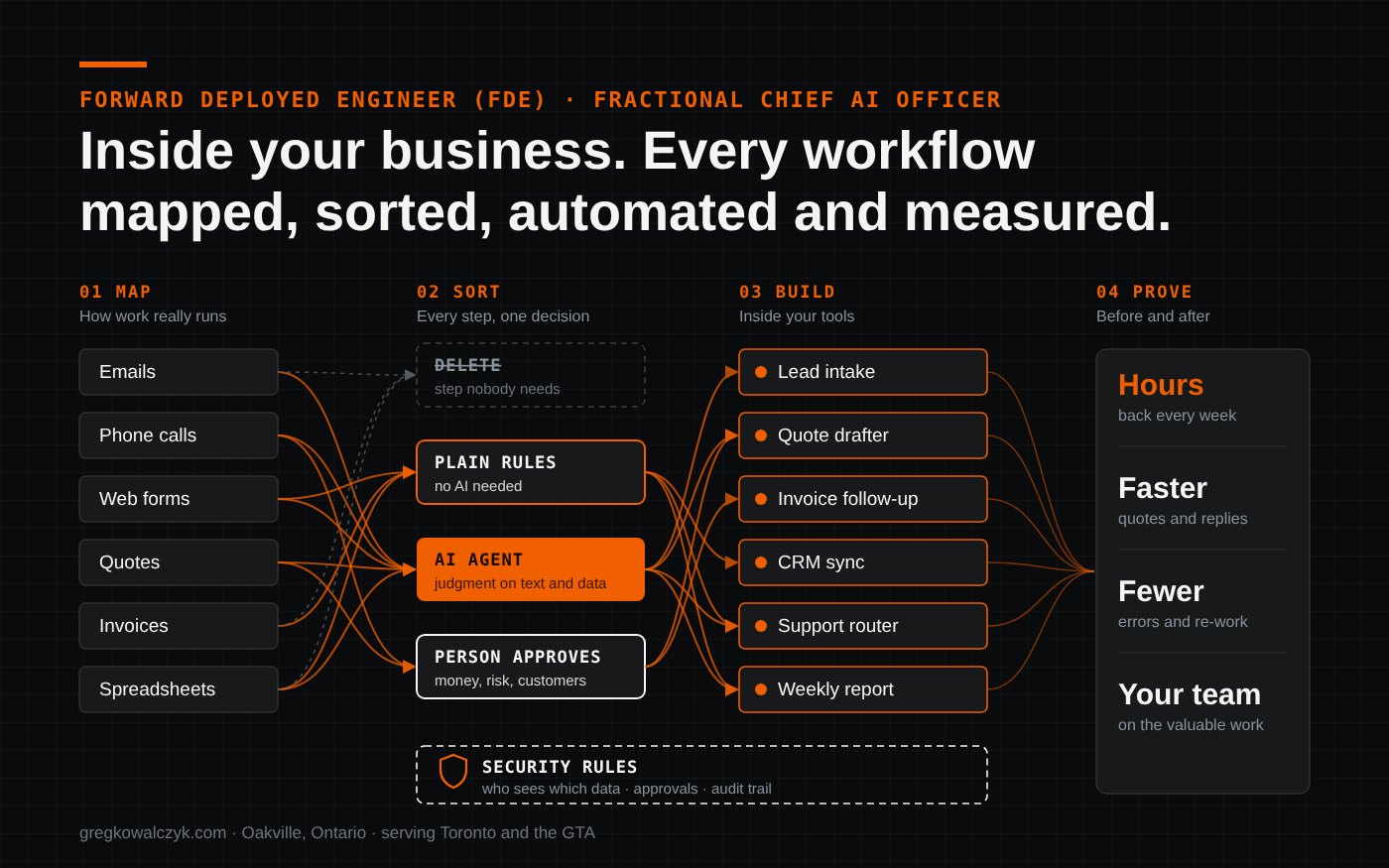
The work follows the same path every time. I call it map, sort, build, prove.
1. Sit with the team and watch the real work
Not the process on paper. The real one: the spreadsheet someone updates every Monday, the emails copied into the CRM by hand, the quote that takes two days because three people touch it. This is where experience matters most. Someone who has run departments and businesses knows which steps are habit and which are necessary.
2. Break the business into process flows
Every recurring job gets drawn as a flow: what triggers it, every step, who does it, how long it takes and where it waits. Lead intake, quoting, ordering, invoicing, reporting, customer questions, hiring. Once the work is on one page, the waste is visible.
3. Sort every step
Each step goes into one of four groups:
- Delete it. A surprising share of steps exist only because nobody questioned them.
- Automate it with plain rules. Copying data between systems, sending reminders, creating tasks. No AI needed.
- Use AI. Steps that need judgment on text or data: drafting replies, summarising calls, reading documents, sorting requests.
- Keep a person. Decisions that carry risk, money or a customer relationship. AI can prepare them; a person approves them.
4. Build the automations in your existing tools
The build happens inside what you already use: your email, your CRM, your accounting software, your Shopify or Amazon account. Nothing changes for your team except that the repetitive work disappears. Typical automations include:
- Lead intake that captures, qualifies and routes every enquiry the moment it arrives.
- Quotes and proposals drafted from your own pricing and past jobs, ready for approval.
- Invoice reminders and payment follow-ups that run on their own.
- Weekly reports built automatically from your real numbers.
- Customer questions answered or routed to the right person.
- Content, product listings and emails written in your brand voice.
5. Set the security rules
AI systems touch customer data, financial data and your internal documents. Before anything goes live, the rules are written down: which systems can see what, where data is stored, which actions need human approval and who can change the setup. This is the part that is most often skipped and the part that matters most when something goes wrong.
6. Measure before and after
Every workflow gets timed before the change and after it. Hours per week, days to send a quote, errors per month, cost per task. If a system does not save time or money, it gets fixed or removed.
7. Hand over and keep leading
Your team gets documentation and training, so the systems run without the person who built them. As fractional Chief AI Officer, the work then continues: the next workflow, the next tool decision and a regular check that every system is still paying for itself.
Why it pays to hire one
You get experience you could not hire full-time. A forward deployed engineer or fractional CAIO has seen how many businesses work. They recognise a broken workflow quickly because they have fixed the same pattern before.
Your people stop doing robot work. The point of automation is not fewer people. It is your best people spending their week on customers, sales, products and decisions instead of copying data and chasing paperwork.
The savings are real because they are measured. In my own two e-commerce brands, AI systems I built replaced more than $75,000 a year of agency work. Every client workflow is measured the same way, before and after.
Someone owns the result. Advice is cheap to give and easy to ignore. A forward deployed engineer is accountable for a system that works. A fractional CAIO is accountable for AI paying off across the business.
Security is designed in, not added later. With one person setting the rules and building the systems, the data and approval rules are part of the build from day one.
It costs a fraction of a full-time executive. You get senior AI leadership and a builder, without a C-suite salary or a six-month hiring process.
What these roles look like in 2027
Two things changed in 2026 that shape the work in 2027.
AI moved from chat windows into the tools you already run. A year ago most businesses used AI by copying text into a chat window. The useful work now happens inside email, the CRM, the accounting software and the online store, where AI agents read, draft and update records on their own. That makes the forward deployed part more important: someone has to connect those systems and decide what each agent may touch.
Demand for the role grew faster than the supply of people who can do it. Large companies are hiring forward deployed engineers in record numbers, as the Fortune report above shows. Small and medium-sized businesses rarely win that hiring race, which is why the fractional model fits them: senior experience for the days you need it.
What does not change in 2027 is the method. Map the work, sort every step, build inside your tools, set the security rules and measure the result.
Signs your business needs one
- The same tasks are done by hand every week, and everyone knows they should not be.
- You have tried AI tools, but nothing is connected and nobody owns the results.
- Your team is busy but the most valuable work keeps getting pushed back.
- You are not sure what data your staff are putting into AI tools.
- You have been quoted six months and six figures for a project that should take weeks.
Hiring a forward deployed engineer in Toronto and the GTA
Forward deployed engineering works best in person, at least at the start. Watching the work is the first step, and that is easier at your desk than on a video call.
I am based in Oakville and work on-site with small and medium-sized businesses across the Greater Toronto Area: Toronto, Mississauga, Oakville, Burlington, Milton and Hamilton. After the first weeks, most of the work can continue remotely, and I work remotely with businesses elsewhere in Canada and the US.
If you want to see how I think before you book anything, come to one of the free AI for Business meetups I host each month in Hamilton and Oakville.
How much it costs
Prices depend on the scope, so every engagement starts small:
- A free 15-minute call. You describe the part of your week that should not need a person. I tell you whether AI can take it and what the first step is.
- The AI Assessment, $1,000. One process mapped and sorted, with a written build plan.
- A Process Map Sprint, from $3,500. A whole department over two to three weeks: interviews, a read-only look at your systems, and today’s numbers written down.
- A fixed-price build. Built inside your tools, measured at 30 and 90 days, and handed over with training. You own everything.
The assessment and the sprint are both credited against the build. The ongoing fractional Chief AI Officer role is priced by the days per month you need.
How I work in both roles
I spent 22 years in engineering, from mechanical designer to Chief Engineer and Manager of Engineering for a 70-person department, where a large part of the job was standardising equipment, processes and designs across offices in Germany, China, India, Canada and the US. Since 2014 I have run two e-commerce brands with my daughter, and every system I build is tested in those businesses first.
Today I work as a forward deployed engineer (FDE) and fractional Chief AI Officer for small and medium-sized businesses. I come into your company, map how the work runs, implement the AI and security systems, and stay until they run. You can read the full method on how I work, see the services and prices, look at what I have built, or book a call.
FAQ
What does FDE stand for?
FDE stands for forward deployed engineer. It is an engineer who works inside a customer’s business, builds the solution there and stays until it runs. Palantir created the role, and AI companies such as OpenAI now use it with their largest customers. Greg Kowalczyk works as an FDE for small and medium-sized businesses in Toronto and the GTA.
What does a forward deployed engineer do?
A forward deployed engineer works inside a client’s business instead of advising from outside. They learn how the work really runs, break it into process flows, build automations and AI systems in the tools the company already uses, and stay until the systems work in daily operations. They are judged on whether the system runs and saves time, not on the report they hand over.
What does a fractional Chief AI Officer do?
A fractional Chief AI Officer leads a company’s AI work part-time, without a full-time executive salary. They decide where AI and automation pay off, set the rules for data and security, choose the tools, oversee the builds and measure what each one saves in time and money. Engagements usually range from a couple of days a month to a few days a week.
What is the difference between a forward deployed engineer and an AI consultant?
An AI consultant usually delivers advice, a roadmap or an audit, then hands it over. A forward deployed engineer delivers working software inside your business and stays through go-live. If your bottleneck is a decision, a consultant can help. If your bottleneck is manual work that someone has to automate, you need a builder.
Why should a small or medium-sized business hire a fractional Chief AI Officer instead of a full-time one?
Most small and medium-sized businesses need senior AI leadership, but not five days a week. A fractional Chief AI Officer brings experience from many businesses, sets direction and security rules, and gets automations built, for a fraction of a full-time executive’s cost. When the work grows, the role can grow with it.
Can one person be both a forward deployed engineer and a fractional Chief AI Officer?
Yes, and in a small or medium-sized business that is often the most efficient setup. The same person who maps your workflows and builds the automations can set the AI direction, write the data and security rules and measure the results, so nothing is lost between the plan and the build.
How does a forward deployed engineer save a business time and money?
By finding the steps people repeat every day and removing them. They map each workflow, delete the steps that add nothing, automate the steps that follow fixed rules, use AI where judgment on text or data is needed, and keep people on the decisions that matter. Every change is measured before and after, so the savings are counted, not assumed.
Where can I hire a forward deployed engineer or fractional Chief AI Officer in Toronto or the GTA?
Greg Kowalczyk is a forward deployed engineer (FDE) and fractional Chief AI Officer based in Oakville, Ontario. He works on-site with small and medium-sized businesses across the Greater Toronto Area, including Toronto, Mississauga, Oakville, Burlington, Milton and Hamilton, and remotely elsewhere in Canada and the US. Engagements start with a free 15-minute call at gregkowalczyk.com/contact.
How much does it cost to hire a forward deployed engineer?
It depends on the scope. With Greg Kowalczyk, work starts with a free 15-minute call. The AI Assessment, which maps and sorts one process and produces a written build plan, costs $1,000. A Process Map Sprint for a whole department starts at $3,500. Both are credited against the build, which is quoted at a fixed price before any work starts.
Sources
- OpenAI careers, Forward Deployed Engineer role description.
- Fortune, report on forward-deployed engineer hiring, September 3, 2026 (Lightcast job-posting data).
- InterviewBit, How Palantir invented forward deployed engineering.
- Wipfli, Does your business need a fractional chief AI officer?
Greg Kowalczyk is a forward deployed engineer (FDE) and fractional Chief AI Officer based in Oakville, Ontario, serving Toronto and the GTA. He runs GearTOP and TapeGeeks, two e-commerce brands he has operated since 2014, and builds AI and security systems for small and medium-sized businesses. Work with Greg →