Forward Deployed Marketing (FDM): What It Is, What It Isn't, and Who It's For
Forward deployed marketing explained by someone who runs it on his own brands: what an FDM builds, how to judge the results, and what you keep when they leave.

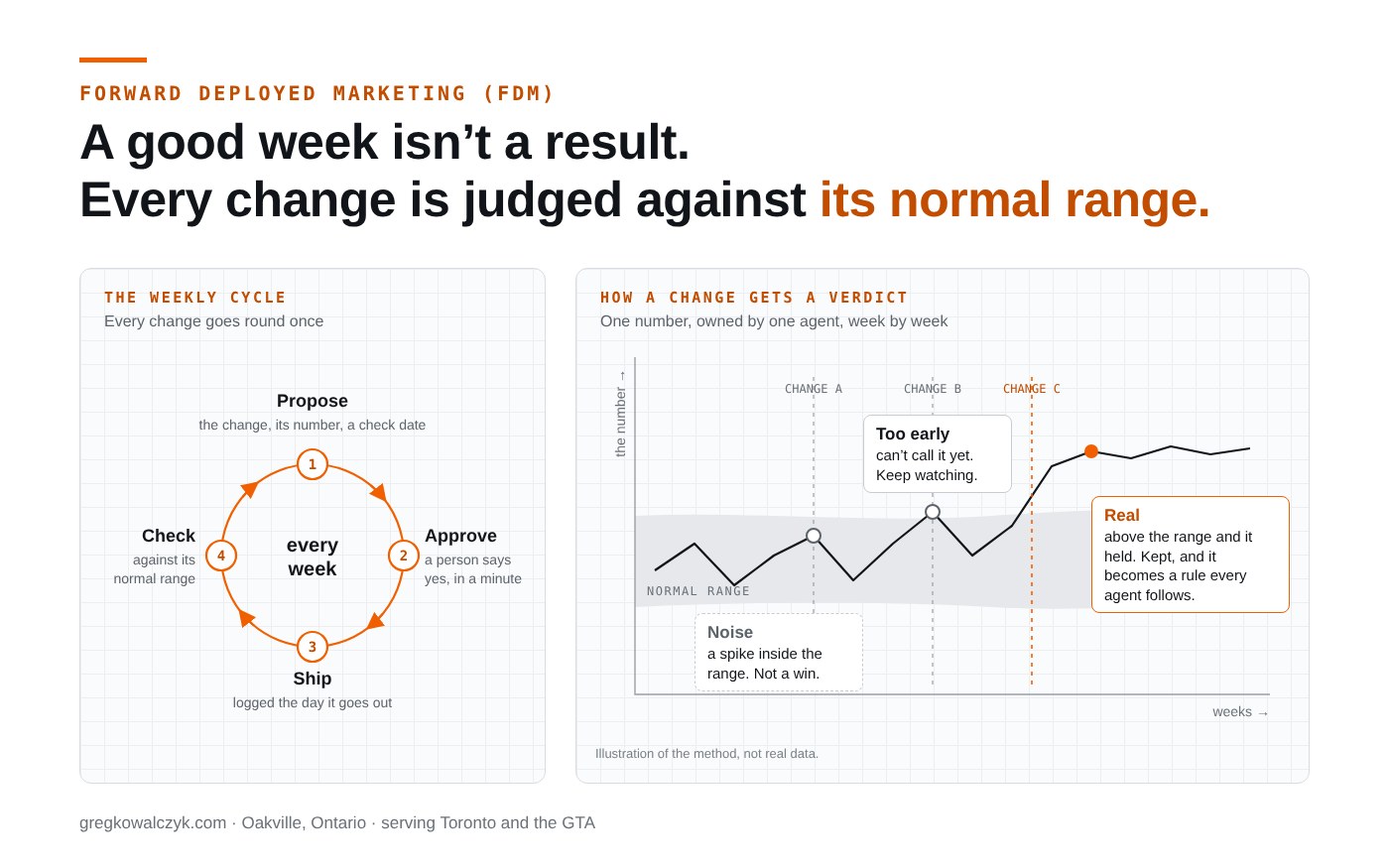
The short answer: forward deployed marketing (FDM) means someone works inside your business and builds the system that runs your marketing, in the tools you already use, then leaves that system with you. In practice that’s your numbers pulled into one place, what you know about your customers written down, AI agents that each look after one number, and a short weekly review that tells you which changes actually worked. You keep all of it.
I’m a mechanical engineer who ended up running two e-commerce brands, GearTOP sun hats and TapeGeeks tape and nasal strips, with my daughter. We run them this way now, and I do the same work for other small businesses. When “forward deployed marketing” started showing up in my feed, most of what I read was written by agencies selling it to big tech companies. So this is the version I wanted to read: what it is, why the name confuses people, how to judge it, and how to spot a rebrand.
What is forward deployed marketing?
Forward deployed marketing is the forward deployed engineer model applied to marketing. A forward deployed marketer (also FDM) embeds in a company’s marketing, builds the system that runs it, connects that system to the company’s own tools and data, and stays close enough to keep it honest. The test is what keeps running after they leave.
The name borrows from the forward deployed engineer (FDE), the role Palantir created for engineers who sit with a customer until the software works in that customer’s real environment. I wrote about that role, and why I use the title, in my guide to forward deployed engineers and fractional Chief AI Officers.
In 2026 the idea crossed into marketing fast. StackedGTM launched a forward deployed marketing arm that places senior operators inside a company to fix one growth problem and hand the working system over within 90 days. Myosin describes it as an embedded model: marketers work inside the company’s real sales and marketing setup to build AI systems, install them and transfer them to the team. Darkroom frames the forward deployed marketer as a senior growth lead who rebuilds a team’s recurring work so AI agents do most of it.
Those definitions mostly agree. The confusion is in the job title.
One name, two very different jobs
Search “forward deployed marketer” and you’ll find job posts with salaries. Read them closely and most describe a different job from the one this post is about.
At AI software companies, a forward deployed marketer works for the vendor. Cognition hired one to work inside the largest customer accounts for its coding agent, Devin, and Hightouch advertised for a founding forward deployed marketer. Profound’s forward deployed marketing engineers sit with customer teams, often on site, and build workflows around Profound’s own product. Those are good jobs. But that person’s success is measured by whether you use their employer’s software.
The other version works for you. They sit inside your marketing, they’re judged on your numbers, and they leave behind something you own regardless of which tools it runs on.
| Vendor-side FDM | Client-side FDM | |
|---|---|---|
| Who pays them | The software company | You |
| What they’re measured on | Adoption of the vendor’s product, case studies | Your marketing numbers, week by week |
| What they build | Your setup of their product | Your system, across the tools you already use |
| What you keep | A configured product | The numbers, the written context, the agents, the review |
Neither is wrong. You just want to know which one you’re talking to. Stuart Brameld at Growth Method makes the same point about vendor FDEs: the engineer may be excellent, but they’re paid to make their employer’s platform stick.
Everything below is about the client-side version, because that’s the one a small business would hire.
How it compares with an agency, a hire or another tool
When I explain this to owners, they usually compare it with three things they already know.
| Marketing agency | Hiring a marketer | Buying another AI tool | Forward deployed marketing | |
|---|---|---|---|---|
| Who does the work | Their team, from their office | Your employee | Whoever on your team finds time | An embedded builder, plus agents |
| What you pay for | Hours and campaigns | A salary | A subscription | A system, then upkeep |
| How you know it worked | Their monthly report | Their judgement | You mostly don’t | Each agent’s number, reviewed weekly |
| When they’re gone, you have | Logins and old PDFs | A job opening | A subscription to cancel | The data, the write-ups, the agents and the routine |
I paid agencies for years. The moment I knew it had to change was Q4 2023: I needed 200 listing updates before the holidays, and the agency quoted six weeks and $8,000. I knew the products better than they did. I just couldn’t produce the work fast enough myself. And when we did part ways, I had logins and a folder of PDF reports. What we’d learned about which offers sold and which ads flopped left with them.
And a marketing engineer or GTM engineer?
These titles overlap. CXL describes a marketing engineer as a marketer who builds AI workflows to take over repetitive work, and reports that the number of people with the title grew 77% in a year. A GTM engineer does similar work across sales and marketing. Most of those are employee roles. “Forward deployed” describes where the person works and who they answer to. Plenty of forward deployed marketers are marketing engineers who happen to work embedded with a client.
What a forward deployed marketer actually builds
There are four parts, and the order matters. I learned that by getting it wrong first (more on that below).
1. Your numbers in one place
Sales, ads, email, social, store data. One record that both your team and your AI tools read from, with at least a year of history so “normal” means something. At my brands the freelancer we used to pay spent four hours every Monday copying numbers from Shopify, Amazon, Google Analytics and Meta into a spreadsheet. Now that report builds itself, and I built Helm so every AI tool I use reads the same numbers instead of guessing.
A couple of habits matter more than which software you use. When Amazon or Meta revises last month’s numbers, keep the old version too, or you can’t check old decisions later. And leave customer names out. Totals and counts are all the system needs.
2. Your context, written down
Your offers and prices. Who buys, and what makes them hesitate. How your brand sounds, and the words it never uses. What you’ve tried and how it went. In most small businesses all of that lives in the owner’s head. That’s fine until you want an AI agent, or a new hire, to act on it. Written down as a few short pages, it becomes the first thing every agent reads before it drafts anything.
3. Agents with one job each
Forget “an AI marketing assistant” that does a bit of everything. Each agent owns one number. At an online store, the listings agent might be judged on conversion and the email agent on revenue per send. Each works inside tools you already pay for. None of them publishes anything or spends a dollar until a person says yes, and no agent ever approves its own work.
Start with one, pointed at whichever goal is furthest behind. I wouldn’t add a second until the first has been checked every week for a while.
4. A weekly review
Most articles on FDM skip this part. I think it matters most, so it gets its own section.
The part most explanations skip: knowing what was real
Most weekly movement in marketing numbers is noise. Sales can jump one week and drop the next with nothing changed. React to every wiggle and you’ll “learn” a dozen things that aren’t true, then undo the changes that were working.
So every change goes through the same routine.
Before it ships, it’s written up: what’s changing, which number it should move, and the date we’ll look. If a change can’t name a number, it doesn’t ship. Then someone says yes or no, which should take a minute, not a meeting.
When the date comes, the result is compared with that number’s own recent normal. Not last week, and not some all-time average. If it lands clearly above the range it usually sits in, that’s a real win. Right at the edge is a maybe. Inside the range is noise, however good the week looked. And if you’re running several tests at once, a couple will look like winners by pure luck, so the bar goes up.
The verdict gets written down: real, probably, or too early to say. With small numbers, “too early” is often the honest answer, and I’d rather say that than guess.
One rule I hold to: the arithmetic decides whether something worked. The AI explains the verdict in plain English. It doesn’t get to reach it.
How one result becomes a rule
A single win is a result, nothing more. When the same idea wins again in the same channel, it’s a pattern. When it wins in a second channel too (say, how-to-fit photos that lift conversion on a sun-hat listing and then win again in ads), it becomes a rule, and it goes into the written-down context from part two. From that day, every agent’s first draft starts from it.
The reverse matters as much. When later evidence stops backing a rule, you mark it retired and keep the record. Delete it and someone runs the same failed idea again next year.
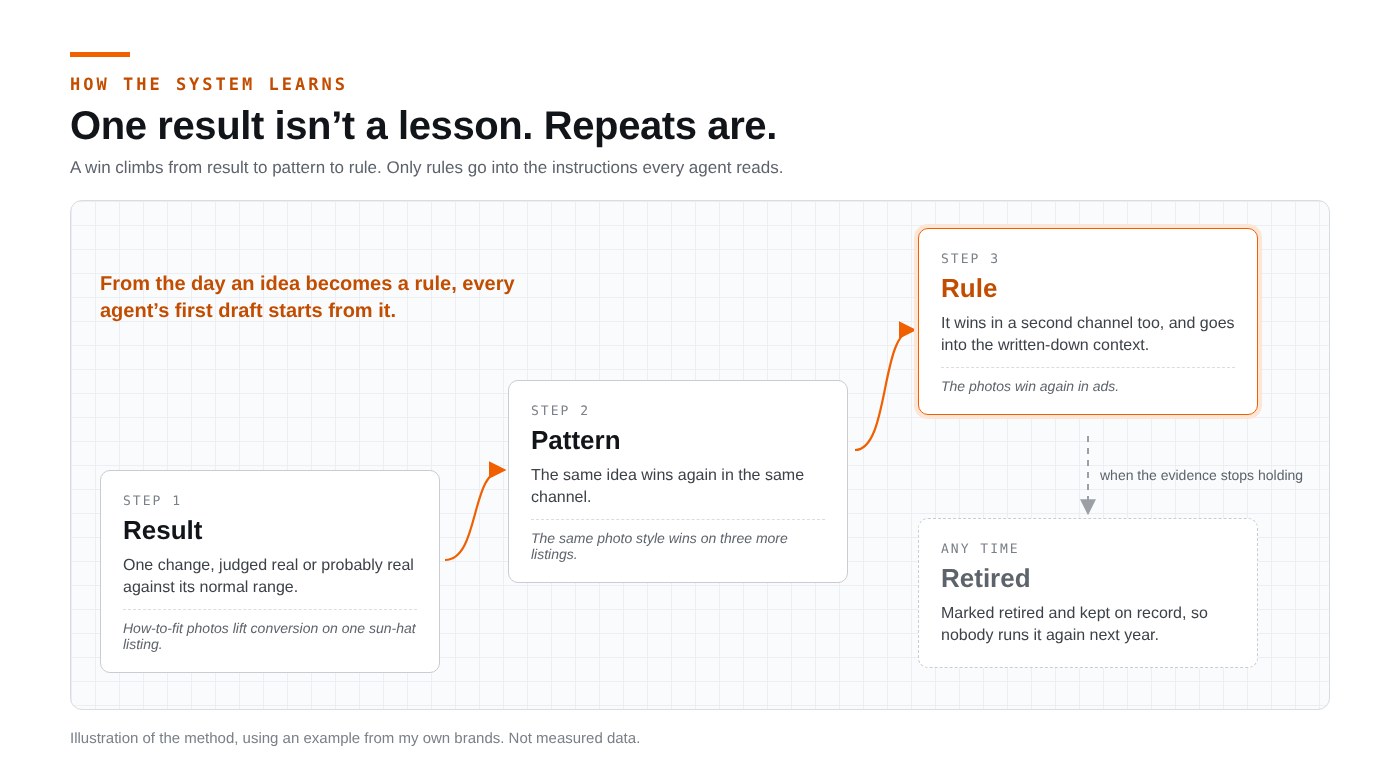
This is why the system improves on its own. On day one the agents know what you wrote down. A few months in, they also know every result that survived the review, and every idea that didn’t.
Who does what
In a small business this is rarely a big team. Usually it’s the owner, whoever already handles marketing day to day, and me.
As the owner, you pick the goals and read the Monday review. Most weeks that’s half an hour: look at the verdicts, say yes or no to what’s proposed, get on with your day. Whoever runs marketing signs off on changes in their own area and keeps doing the work only a person should do, like the product shoot or the call with an unhappy customer. I build the system and keep it running until someone on your team is ready to take it over.
The agents draft, suggest and handle the repetitive work. They never sign off on their own changes. Neither does anyone else. And revenue always gets checked against your books, not against what an ad platform says it drove.
If I had to name the one thing that kills this, it’s skipping the Monday half hour. Without it, all you’ve built is another report.
The first month
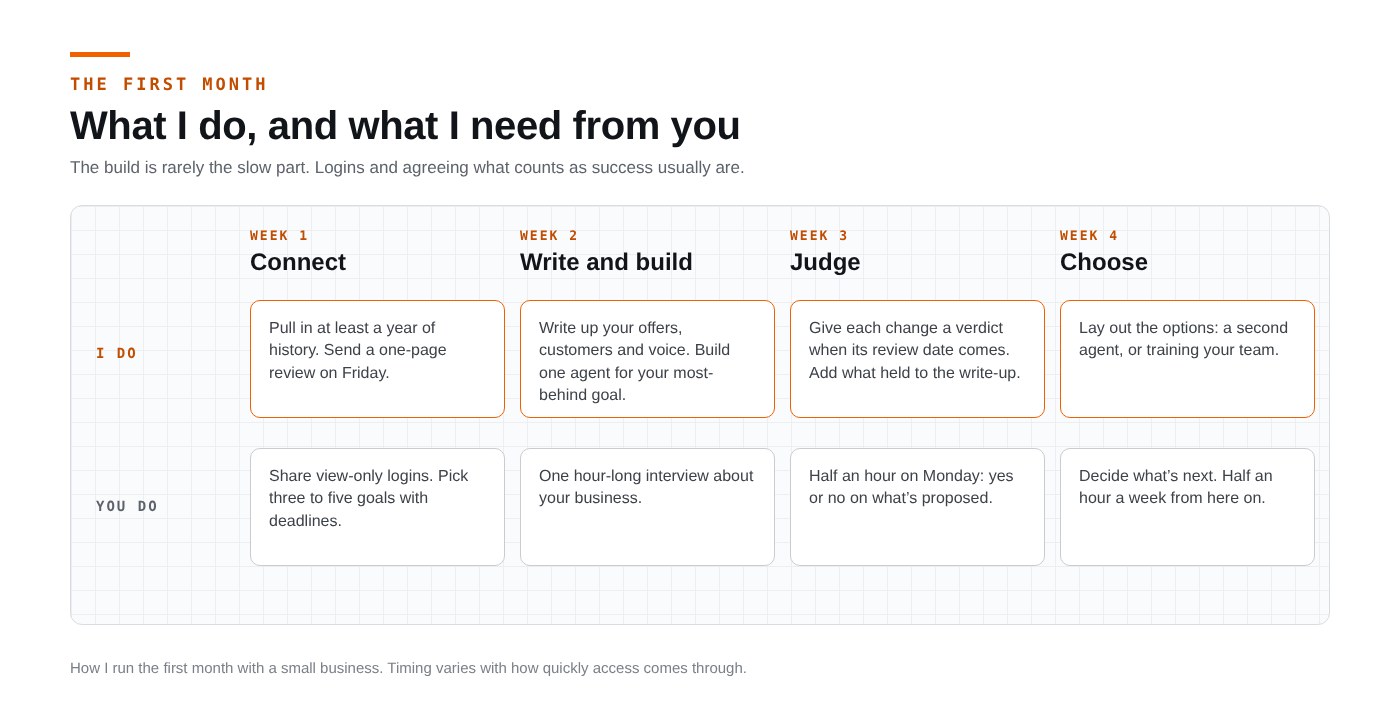
This is roughly how the first month goes when I start with a business, and what I need from you each week.
- Week 1, connect. You give me view-only logins. I pull in at least a year of history, and we agree on three to five goals with deadlines. You get a one-page review on Friday.
- Week 2, write and build. I interview you for about an hour on your offers, your customers and how you sound, and write it up. Then I build one agent, aimed at the goal you’re furthest behind on.
- Week 3, judge. The first changes reach their review dates. Each gets a verdict, and anything that held goes into the write-up.
- Week 4, choose. We decide together: add a second agent, or have me train someone on your team to run the first one.
Honestly, the build is rarely what holds things up. Waiting on logins and agreeing on what counts as success usually take longer.
What stays when they leave
Gartner put a number on the risk, and it’s not small. It predicts that by 2028, 70% of enterprises will abandon the agentic AI that vendor forward deployed engineers built for them, because it costs too much to keep and they can’t change it on their own. It also warns about “FDE washing”: ordinary consulting and implementation work relabelled as forward deployed. The same thing is already happening with “forward deployed marketing.” It sounds better than “agency.”
So agree up front on what’s yours at the end. In my engagements, you keep your data, connected and readable by your team without me. You keep the write-ups: your offers, customers and voice, plus the log of every change and its verdict. The agents run in your accounts, with your logins. And the weekly routine is short enough that someone on your team can run it without help.
If all you keep is logins and a final report, it was an agency engagement with a new name.
Where it goes wrong
I made all of these mistakes moving my own brands off agencies, so I watch for them with clients now.
I tried to rebuild content, reporting and email in the same stretch. Too much. I’d do one system at a time now, starting with whichever pays back fastest.
I scaled content before the brand voice was settled. For the first few months I kept rewriting the instructions, and older posts ended up sounding like a different company. Settle the voice first.
I didn’t write down “before” numbers. Some of my comparisons still lean on memory instead of data. Write today’s numbers down before you change anything.
And I built agents before the numbers were connected. Lots of output, and no way to tell which of it worked. That’s the reason numbers come first in the build order above.
Does forward deployed marketing work for a small business?
Almost everything published on FDM so far is aimed at enterprise and venture-backed tech companies. Myosin, for example, frames it around companies with an established go-to-market motion and leadership involvement. I’d argue small businesses are the better fit. They use the same tools as the big companies (Shopify, Klaviyo, Meta, Google, Amazon), and there’s nobody whose job is to connect them.
You’re probably ready if most of these sound like your business:
- You could say, without looking anything up, which two or three numbers would make this a good year.
- Checking those numbers today means logging into several different tools.
- You’ve changed prices, ads or emails recently and couldn’t say for sure whether it helped.
- What your customers care about, and how your brand should sound, lives mostly in your head.
- Someone on your side can give it half an hour on Mondays.
If the first three ring true but nothing is written down yet, the first month is mostly about getting the numbers and the write-up in place. If you already have both, the agents can start in week one.
It isn’t the right fit when:
- You haven’t found product-market fit yet. Automating a message that doesn’t sell just sells nothing, faster.
- Nobody on your side will own the weekly review.
- You’d rather someone ran your marketing for you indefinitely. That’s an agency, and there’s nothing wrong with that. Hire a good one.
How I run it on my own brands
My daughter and I have run GearTOP and TapeGeeks since 2014. Every system I build for a client gets tested there first, and the results are public in how I replaced $75K in agency costs.
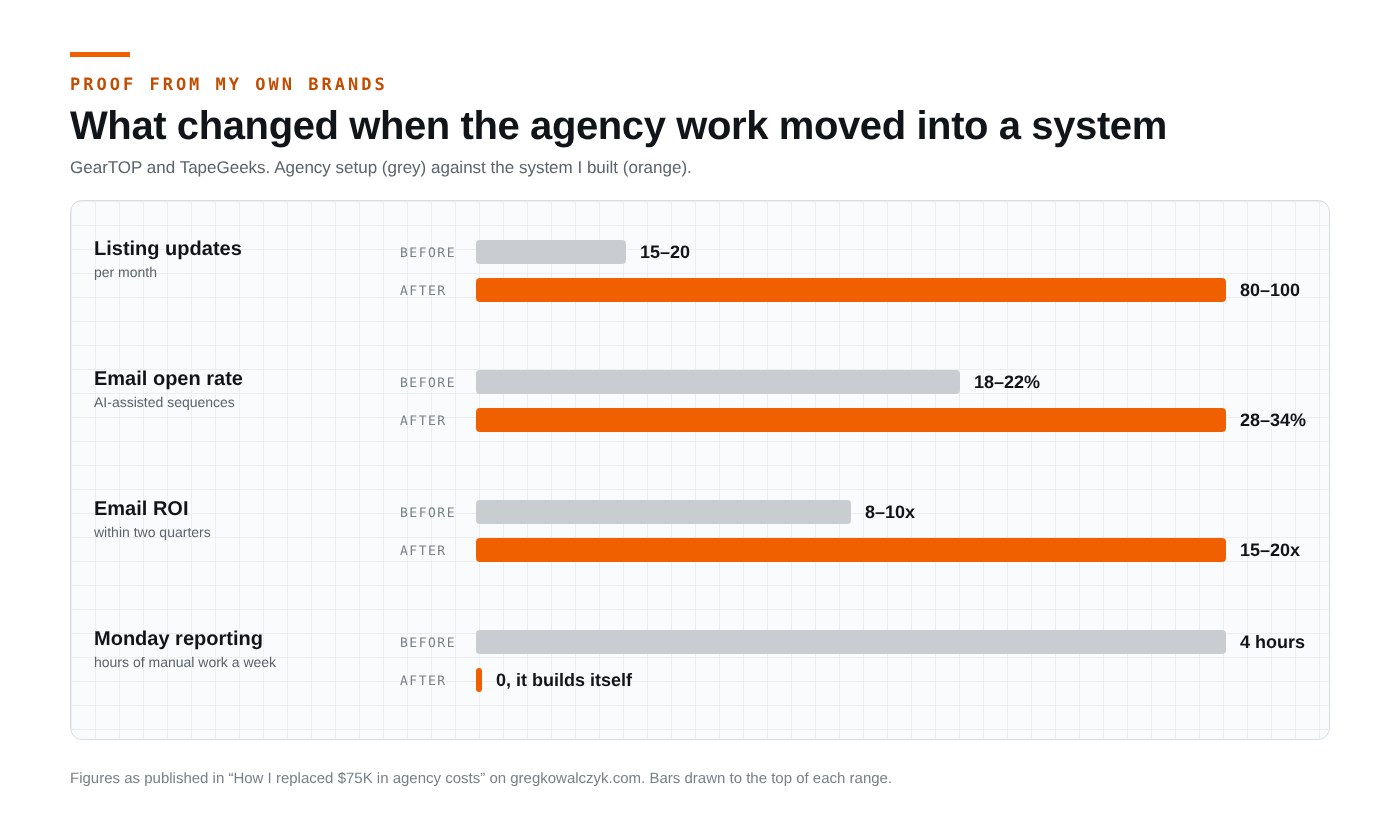
If I’m telling you to judge this on numbers, I should show mine:
- Listing updates went from roughly 15–20 a month at agency capacity to 80–100 a month.
- Email open rates on AI-assisted sequences run 28–34%, against 18–22% with the agency copy.
- Email ROI moved from roughly 8–10x to 15–20x within two quarters.
- The Monday reporting job, four hours a week, is gone.
Before you hire anyone for this
Whoever you talk to, me included, should be able to answer these without hand-waving.
- Can you show me a weekly review from a real client, or your own business? If they can’t, they haven’t run one.
- What happens to a change that looked good but sat inside the normal range? You want to hear that it wasn’t counted as a win.
- Whose accounts do the agents run in? If the answer isn’t “yours,” you’re renting.
- What’s in the handover? Listen for data, write-ups, agents and a routine. “A final report” is the wrong answer.
- How many hours a week will my team spend on this? A specific, small number is a good sign. “It depends” isn’t.
What it costs
Prices vary so much between providers that I won’t pretend there’s a typical number. Here’s how mine works. Work starts with a free 15-minute call. The AI Assessment costs from $1,000 and maps one process, with a written build plan. What you pay for it is credited against the build. The build is quoted at a fixed price before anything starts. Ongoing forward deployed marketing is billed monthly, priced by the scope of the work, because a business with one store and an email list needs far less than one selling on Amazon, Shopify and wholesale.
Details are on the forward deployed marketing service and on how I work.
FAQ
What is forward deployed marketing?
Forward deployed marketing (FDM) is the forward deployed engineer model applied to marketing. Instead of running campaigns from outside like an agency, a forward deployed marketer works inside the business and builds the system that runs its marketing, in the tools it already uses, then leaves that system with the team.
What does FDM stand for in marketing?
FDM stands for forward deployed marketing, or for the person who does it, a forward deployed marketer. The name comes from the forward deployed engineer (FDE), a role Palantir created for engineers who work inside a customer’s business until the software runs there.
What is the difference between a forward deployed marketer and a marketing agency?
An agency works from outside on a retainer and delivers campaigns and a monthly report. A forward deployed marketer works inside your business and delivers a running system, with your numbers, your written-down context, AI agents and a weekly review. When an agency leaves, you keep account access. When a forward deployed marketer leaves, you keep the system.
Is a forward deployed marketer the same as a marketing engineer?
They overlap. A marketing engineer is a marketer who builds AI workflows and automations, usually as an employee. Forward deployed describes where the person works and who they answer to, inside your business and measured on your numbers. Many forward deployed marketers are marketing engineers who work embedded with a client.
Is forward deployed marketing only for large companies?
No. Most of what has been written about it targets enterprise and venture-backed tech companies, but small businesses often benefit more, because they have the same tools and data with nobody to connect them. The model fits a small business that already sells, has data in a few tools and is paying an agency or freelancers for repeat work.
How do you measure whether forward deployed marketing is working?
Give every AI agent one number it is responsible for, write down that number before anything changes, and review it every week against what normal movement looks like. A change is kept only when the result is bigger than the usual week-to-week noise. If nobody can tell you which number each agent owns, it is not being measured.
What should you own when a forward deployed marketing engagement ends?
Your connected data, the written-down offers, customers, brand voice and log of results, the agents running in your own accounts, and a weekly routine your team can run without help. If you only keep logins and a final report, it was an agency engagement with a new name.
How much does forward deployed marketing cost?
It depends on the scope. With Greg Kowalczyk, work starts with a free 15-minute call and an AI Assessment from $1,000 that is credited against the build. The build is quoted at a fixed price before work starts, and ongoing work is billed monthly, priced by the scope of the work.
Sources
- StackedGTM, Today, we’re launching Forward Deployed Marketing.
- Myosin, What Is Forward Deployed Marketing?, July 28, 2026.
- Darkroom, What Is a Forward Deployed Marketer (FDM)?
- Adam Woozeer, The forward deployed marketer: one job title, three different jobs.
- Profound, Forward Deployed Marketing Engineer role description.
- Growth Method, From Forward Deployed Engineer to Forward Deployed Marketer.
- CXL, What is a marketing engineer, and why are companies hiring them?
- Gartner, Gartner Predicts 70% of Enterprises Will Abandon Agentic AI Built by Vendor Forward-Deployed Engineering by 2028, September 29, 2026.
- James Dickerson (Boring Marketing), forward-deployed marketing workshop board, which shaped how I explain the weekly review and the order of the build. boringmarketing.com
- Procurement Magazine, Gartner: Will Procurement Abandon Agentic AI Built by FDEs?
Greg Kowalczyk is a forward deployed engineer (FDE) and fractional Chief AI Officer based in Oakville, Ontario, serving Toronto and the GTA. He runs GearTOP and TapeGeeks, two e-commerce brands he has operated since 2014, and builds the systems that run marketing and operations for small and medium-sized businesses. Work with Greg →