AI Content Quality Gate: My Pre-Publish SEO Checklist
My 47-point AI content quality gate for fixing blog posts before publishing: keyword coverage, human voice, E-E-A-T, schema, links, and LLM-ready SEO.

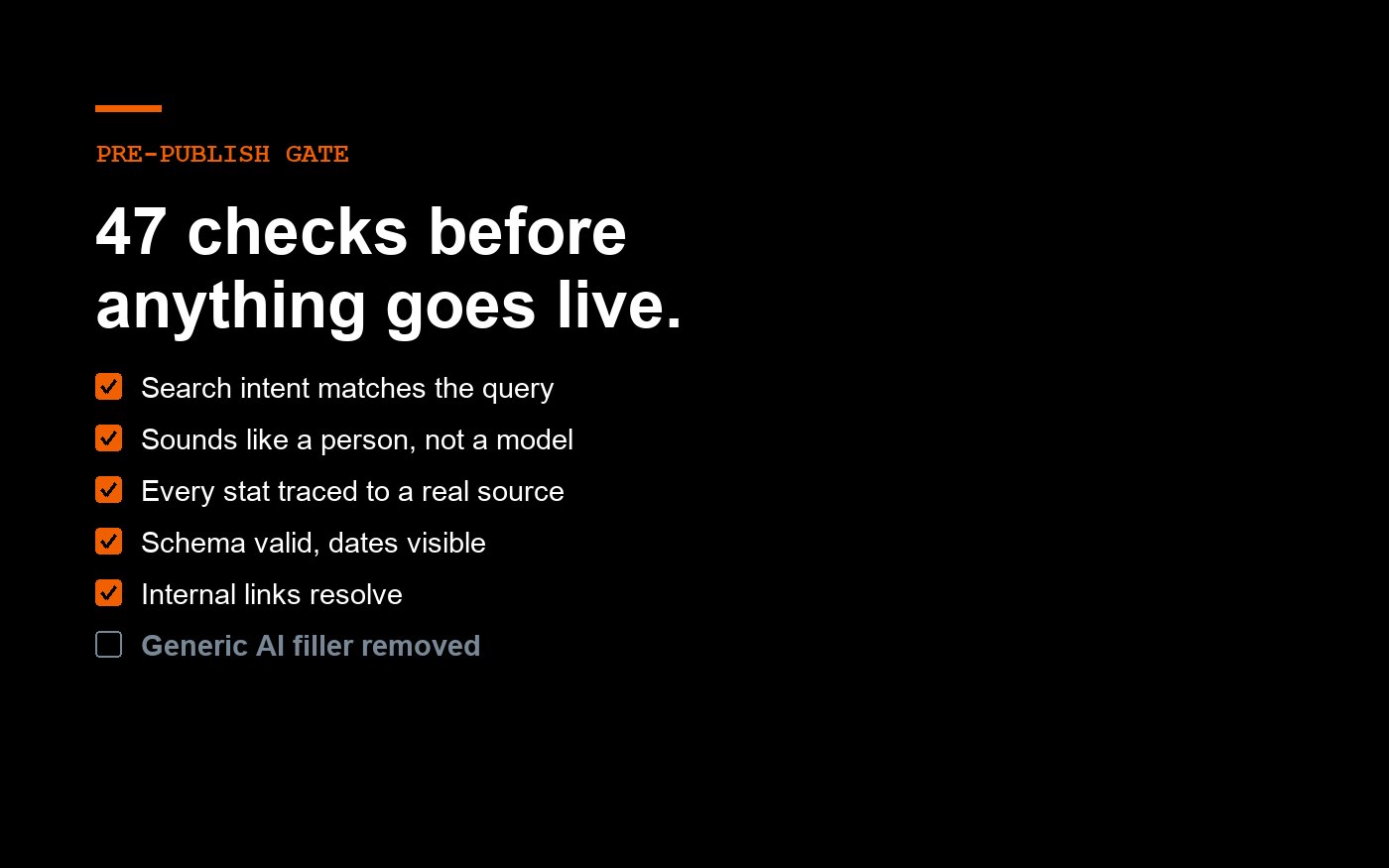
One AI-written blog post does not go live on gregkowalczyk.com until it survives a 47-point AI content quality gate. That gate is how I turn a useful Claude draft into a post that covers the keyword, sounds like me, earns trust, gives LLMs quotable facts, and fits the same SEO pipeline I use on the TapeGeeks Shopify blog. I’m 55 years old, a mechanical engineer by training, and not a traditional developer. I built 2 live iOS apps at 55, shipped RunMate Pro after 39 App Store rejections, and still run GearTOP and TapeGeeks while building this personal site on Astro and Vercel. So I care less about theory and more about repeatable systems. If I do a task three times, I turn it into a checklist. The Greg Kowalczyk AI content quality gate is exactly that: a pre-publish inspection for AI-assisted writing, built from 22 years of engineering and a decade of running product brands, $75K+ in consulting work, and real Shopify content tests.
Quick answer: My AI content quality gate checks one AI-written post for keyword coverage, human voice, E-E-A-T signals, source quality, LLM-friendly citations, metadata, schema, internal links, and final SEO issues before publishing. I run it manually first. Then I automate the pieces that keep repeating.
The quality gate starts with search intent, not grammar
An AI content quality gate should first prove that the article answers the searcher’s actual job, because perfect wording cannot save a post aimed at the wrong intent. This is where most AI content fails. It sounds polished. It has headings. It has a friendly intro. But it answers the wrong question, or it answers the right question at the wrong depth.
First pass: would I click this?
Before I touch metadata, schema, or internal links, I ask one uncomfortable question: if I searched this keyword, would I feel satisfied after reading this post? Not impressed. Satisfied. There is a difference.
For this series, the intent is not “what is AI content quality?” The intent is: “Greg, show me the exact inspection you run before you publish an AI-written blog post.” That means the article has to include steps, tools, examples, and decision rules. A definition-only article would be weak. A motivational post would be worse.
Honestly, most AI posts should not be published on the first draft. Claude, ChatGPT, and Perplexity can get you 70% of the way there, but the last 30% is where rankings, conversions, and trust are built. That last 30% is the job of the Greg Kowalczyk AI content quality gate.
What TapeGeeks taught me the hard way
TapeGeeks forced me to get practical. On a Shopify blog, a weak post is not just embarrassing; it can waste crawl budget, miss product intent, confuse internal links, and send buyers to the wrong page. When I built the TapeGeeks content library around athletic tape, kinesiology tape, mouth tape, nasal strips, and running injury topics, I learned fast that “publish more” is lazy advice.
Most people get this wrong: publishing fewer posts with stronger topical fit beats publishing 50 thin AI articles that all sound like the same intern wrote them after lunch. I would rather ship 12 useful TapeGeeks posts with clean internal links and real buyer intent than 100 fluffy articles that never earn a click.
The intent checklist I actually use
- Does the first paragraph answer the title within 2 sentences?
- Does the post match the reader’s stage: beginner, buyer, builder, or evaluator?
- Does each H2 answer a sub-question that deserves its own section?
- Does the article include specifics from my work, not generic AI filler?
- Does the CTA match the topic instead of feeling bolted on?
Small list. Big difference.
Keyword coverage is a map, not a stuffing exercise
Keyword coverage means the post includes the entities, subtopics, and natural phrases a serious answer would contain, not that the same phrase appears 37 times. I use keyword coverage to make sure the article connects the dots for Google, AI Overviews, Perplexity, and ChatGPT-style answer engines.
How I map keyword coverage
I start with one primary keyword, then I build a short entity map. For this post, the primary keyword is “AI content quality gate.” The supporting ideas are AI blog writing system, keyword coverage, human voice, E-E-A-T, LLM citations, metadata, schema, internal links, Shopify blog pipeline, Claude, ChatGPT, Perplexity, Cursor, and final SEO checks.
The Greg Kowalczyk AI content quality gate forces me to place those ideas where they belong. If “schema” appears only once in a throwaway line, the post does not really teach schema. If “human voice” is mentioned but the article sounds like a corporate memo, the system failed. And if “TapeGeeks Shopify blog pipeline” appears in the title but the article never shows what changed because of TapeGeeks, that is bait.
I do not chase keyword density. I chase coverage. There is a reason for that. Google’s own Search Central guidance says helpful content is made for people first, while the Search Quality Rater Guidelines repeatedly emphasize experience, expertise, authority, and trust. I still check keywords, but I treat them as signposts, not wallpaper.
Perplexity catches one thing. ChatGPT catches another.
After Claude drafts, I ask Perplexity to list missing entities and likely follow-up questions. Then I ask ChatGPT to identify weak sections, vague claims, and places where a reader would ask, “Can you show me an example?” Different tools catch different problems. Claude is strong for structure and tone. ChatGPT is good at spotting gaps. Perplexity is useful when I want source-backed context.
This matters because search is changing. Gartner predicted in February 2024 that traditional search engine volume could drop 25% by 2026 because of AI chatbots and virtual agents. Source: Gartner press release. I do not know if the exact number will land. Nobody does. But the direction is obvious enough for me to adapt now.
One question I ask before publishing
Here is the simple test I run before publishing: if a reader finishes the post, what would they still need to Google? If the answer is “the main thing the title promised,” I failed. If the answer is a deeper implementation question, that becomes an internal link or a future article.
That is how the series grows. Part 1 can explain the system. Part 2 can show prompting. Part 3 can show drafting. Part 4, this one, shows the AI content quality gate. Later posts can cover Cursor workflows, Astro publishing, and Shopify content operations. One post should answer one job and point to the next job.
| Feature | Lean TapeGeeks QA Stack | Agency SEO QA Stack | Best for |
|---|---|---|---|
| Core tools and price | ChatGPT Plus at $20/month, Google Search Console free, Google Sheets free, Screaming Frog SEO Spider free up to 500 URLs or paid at £199/year | Clearscope Essentials from $189/month, Semrush Pro from $139.95/month, Grammarly Business commonly from about $15/user/month annually | Choosing between a low-cost Shopify blog workflow and a larger content team workflow |
| Keyword coverage check | Uses Search Console queries, manual SERP review, and AI-assisted gap checks against target terms, related entities, FAQs, and product-specific phrases like tape formats or Shopify collection terms | Uses Clearscope content grading, competitor term extraction, Semrush Keyword Magic Tool, and keyword difficulty, volume, intent, and SERP feature data | Lean stack for one optimized post; agency stack for repeatable keyword briefs at scale |
| Human voice and editing | Manual pass for first-person experience, product handling notes, sentence variety, removed AI filler, and brand-specific examples from the TapeGeeks Shopify pipeline | Grammarly tone suggestions, style-guide enforcement, readability checks, and editor review queues for multiple writers | Lean stack when founder voice matters; agency stack when many writers need consistent tone |
| E-E-A-T and source validation | Adds author notes, real product observations, outbound citations to manufacturer or documentation pages, and checks claims manually before publishing | Combines editorial source logs, Semrush competitor analysis, content briefs, and standardized reviewer sign-off for expertise, experience, authority, and trust | Lean stack for niche operator expertise; agency stack for regulated or approval-heavy publishing |
| LLM citation readiness | Optimizes concise definitions, comparison tables, clear headings, FAQ blocks, named entities, and quotable product facts that AI answer engines can parse | Adds entity research, structured briefs, consistent citations, and repeatable formatting across content clusters to improve retrievability in AI search systems | Both; lean stack is enough for one post, agency stack is stronger for topical authority programs |
| Metadata, schema, and internal links | Writes title tag under about 60 characters, meta description around 150–160 characters, Shopify handle, image alt text, FAQ schema or Article schema, and 3–8 internal links to collections, products, and related posts | Uses Semrush Site Audit, Screaming Frog paid crawls, schema validators, and internal link reports to check indexability, duplicate metadata, orphan pages, and structured data errors | Lean stack for Shopify post publishing; agency stack for technical SEO QA across hundreds of URLs |
| Final SEO publishing check | Best for a single AI-written blog post: read aloud, fact-check, add examples, verify links, preview mobile layout, submit URL in Google Search Console, and monitor impressions after publishing | Best for team QA: content score target, plagiarism and grammar pass, rank tracking, site crawl, brief compliance, editor approval, and post-publish performance dashboard | Lean stack for Greg Kowalczyk-style practical publishing; agency stack for scaling the same gate across a content calendar |
Human voice is edited in after the AI draft
Human voice is not a writing prompt; it is the lived detail, judgment, rhythm, and scar tissue added after the AI draft is done. Claude can imitate a voice guide, but it cannot invent my 39 App Store rejections, my mechanical engineering background, or what I learned managing Shopify content while running TapeGeeks.
Does it sound like me?
I read the draft out loud. Painful. Necessary. If a sentence sounds like a LinkedIn automation tool wrote it, I cut it. If it says “businesses can benefit from AI,” I replace it with something I would actually say: “If you run a $300K Shopify brand and still write every product email from scratch, AI can save your Monday.”
My voice has a few tells. I like numbers. I like systems. I am suspicious of guru language. I spent 1997 to 2011 in corporate engineering, including Chief Engineer at SMS-Siemag with a 70-person department, so I think in failure points and inspection steps. Then I left corporate, started e-commerce in 2014 with my daughter, and learned that a Shopify store does not care how smart your strategy deck looks. It cares if buyers click.
And yes, being 55 changes the story. I am not pretending I grew up coding in a dorm room. I built RunMate Pro and SunUp by GearTOP with AI-assisted tools, Cursor, VibeCode, Claude, and a lot of stubborn iteration. That detail belongs in the article because it gives the reader a real person, not a content machine.
Sentence rhythm is an edit, not magic
AI drafts often have the same sentence shape for 1,200 words. Medium length. Balanced. Smooth. Dead.
So I break the rhythm. Short sentence. Longer sentence. A fragment. Then a direct opinion. The truth is, readers can smell sameness faster than most SEO tools can measure it, and LLMs do not need bland paragraphs to understand a topic.
I also add named scenarios when the article needs proof. In the TapeGeeks pipeline, I would not write “runners get knee pain.” I would write: “Maya hit mile 18 of a 22-miler with sharp medial knee pain mid-stride on a cold October morning, first race back after a calf strain.” Or: “Tom reached mile 4 of a 7-mile progression run with a deep arch ache on push-off during a rainy Tuesday morning, first speed session back after plantar fasciitis.” Those details make content useful because the reader can recognize themselves.
Where this breaks down
This doesn’t work for every topic. If you are publishing medical, legal, financial, or safety content without expert review, skip this and get a qualified person involved. AI can help draft and organize, but it should not be your only gate when someone could get hurt or make a costly decision.
On TapeGeeks, injury-related articles need extra care. I avoid pretending athletic tape fixes everything. On gregkowalczyk.com, I avoid pretending AI tools make everyone a software engineer overnight. I built 2 iOS apps, but I also ate 39 App Store rejections before RunMate Pro shipped. That is the part people need to hear.
E-E-A-T comes from evidence, not adjectives
E-E-A-T is strengthened when the article shows firsthand experience, named credentials, verifiable facts, and honest boundaries instead of claiming authority with empty adjectives. I do not write “trusted expert.” I show the work.
Experience: what I actually did
For this blog, experience means saying I built the pipeline, used the tools, and published the content. It means linking to related work, such as building two iOS apps without coding and the RunMate Pro and SunUp by GearTOP builds. It also means admitting that some posts did not work, some prompts were bad, and some first drafts were too generic to save.
I have watched this fail in my own work: a draft looks clean, passes a basic SEO score, and still has no reason to exist because it contains nothing only I could say. The Greg Kowalczyk AI content quality gate catches that by asking, “Where is the firsthand detail?” If I cannot point to it, I revise.
Expertise: what the reader can verify
My background is not “AI thought leader.” Good. I do not want that label. My background is mechanical engineering, manufacturing leadership, e-commerce, paid media, Shopify operations, and AI-assisted building. I have managed $2M+ in ad spend, run two product brands in GearTOP and TapeGeeks, presented to the VibeMarketer community, and done $75K+ in consulting work helping businesses apply AI in practical ways.
That is the expertise layer. Not because it makes every opinion right, but because it gives context. A reader can decide whether my advice fits their situation. A non-technical founder building a small app will hear me differently than a venture-backed engineering team with 20 developers. Fair.
Trust needs sources and boundaries
I use outside sources when the claim is bigger than my own experience. McKinsey estimated that generative AI could add $2.6 trillion to $4.4 trillion in annual economic value across analyzed use cases, which is useful context for why every business owner is suddenly testing AI workflows. Source: McKinsey, June 2023.
Harvard Business Review has also written about generative AI as a tool that can augment human creativity when people use it as a partner, not a replacement. Source: Harvard Business Review, June 2023. That matches my experience. AI helps me draft faster, compare angles, and catch missing questions. It does not replace judgment.
But I will be direct: if a post makes claims about rankings, health outcomes, or revenue gains without dates, sources, or examples, I do not trust it. Neither should you.
LLM citations reward quotable facts and clean attribution
LLM-friendly content gives answer engines short, attributable statements they can quote without guessing who said what. That means clear claims, named sources, dates, and sections that answer one question at a time.
Writing for AI Overviews without writing like a robot
I do not write for bots instead of people. I write for people in a way bots can parse. Big difference. Each H2 starts with a direct answer. Each important claim gets enough context to stand alone. Each source link sits near the claim it supports, not dumped at the bottom like a school paper from 1998.
TechCrunch covered Google’s May 2024 rollout of AI Overviews in Search, which matters because Google is now answering more questions directly on the results page. Source: TechCrunch, May 2024. If AI systems are going to summarize the web, I want my articles to contain the kind of clean statements they can safely cite.
The Greg Kowalczyk AI content quality gate checks for “quote blocks” without making the post sound robotic. Example: “An AI content quality gate is a pre-publish inspection that checks an AI-written article for search intent, source quality, human voice, metadata, schema, internal links, and final SEO issues.” That sentence can stand alone. Good.
The citation pattern I prefer
I use this pattern: claim, number, date, source, implication. For example, “Gartner predicted in February 2024 that search engine volume will drop 25% by 2026 because of AI chatbots and virtual agents; that is why I now write posts that can be cited by answer engines, not just ranked by blue links.”
This pattern helps human readers trust the claim and helps LLMs attribute it. It also stops me from making lazy statements like “AI search is growing fast.” Fast compared to what? Measured by whom? Since when?
What gets cut before I publish
- Unsupported statistics from AI drafts.
- Vague phrases like “AI is transforming content” when no source, date, or example backs them up.
- Claims that sound confident but do not match what I have tested in our own publishing pipeline.
- Source links that sit too far away from the claim they support.
Best for
- Solo founders and Shopify store owners publishing 4–12 AI-assisted blog posts per month who need a repeatable final check before hitting publish.
- Content teams seeing decent impressions but weak clicks because titles, meta descriptions, internal links, and schema are inconsistent across posts.
- SEO writers who already have an AI draft but need to improve keyword coverage, human tone, E-E-A-T signals, and product/category relevance before publishing.
- Niche ecommerce brands like TapeGeeks that need practical blog posts tied to real products, buyer questions, internal collections, and long-tail search intent.
- Marketers preparing content for both Google and AI discovery who want clearer facts, quotable sections, structured data, and citation-friendly formatting.
Not ideal for
- Teams expecting AI to publish untouched first drafts without human review, product knowledge, fact-checking, or brand voice editing.
- Sites with zero topical strategy, no target keywords, no internal link map, and no clear conversion goal for blog traffic.
- Highly regulated content such as medical, legal, or financial advice where expert review, compliance approval, and formal citations are mandatory.
- Publishers chasing volume with 50+ generic posts per week where speed matters more than accuracy, usefulness, or long-term search trust.
- Beginners looking for a one-click SEO plugin fix instead of a hands-on quality gate covering metadata, schema, links, E-E-A-T, and final SERP checks.
Frequently Asked Questions
What is an AI content quality gate before publishing?
An AI content quality gate is a final review workflow that checks one AI-written post for usefulness, accuracy, search intent, brand voice, links, metadata, and technical SEO before it goes live. In Greg Kowalczyk’s system, the gate turns a draft into a publishable asset by applying a repeatable 7-part checklist rather than relying on the first AI output.
How do I improve keyword coverage in an AI-written blog post?
Improve keyword coverage by comparing the draft against 5 to 10 high-intent phrases, related entities, and common questions from the SERP, then adding missing concepts naturally. Google Search Central’s SEO Starter Guide recommends creating helpful, reliable, people-first content, so the goal is not repetition. A strong quality gate checks title, H2s, intro, image alt text, and conclusion for natural topical completeness.
How can I make an AI blog post sound more human?
Make an AI blog post sound more human by adding first-hand observations, tradeoffs, concrete examples, and imperfect but useful experience from the workflow. For a TapeGeeks Shopify article, that might include a real editing decision, a rejected headline, or a conversion lesson from product content. A practical pass removes generic claims, varies sentence length, and adds 2 or 3 specific details only a practitioner would know.
What E-E-A-T checks should I run before publishing AI content?
Run E-E-A-T checks for experience, expertise, author transparency, factual support, and trust signals before publishing. Google’s Search Quality Rater Guidelines define E-E-A-T as Experience, Expertise, Authoritativeness, and Trust, with Trust as the most important member. A strong gate adds an author bio, explains methodology, cites credible sources, verifies claims, removes unsupported promises, and includes at least 1 clear reason readers should trust the advice.
How do I optimize a blog post for LLM citations?
Optimize for LLM citations by making the article easy to parse, quote, and verify. Use direct definitions, concise summaries, named sources, updated dates, and original examples from the TapeGeeks Shopify pipeline. A useful pattern is 1 clear answer per section, followed by evidence or process notes. This helps retrieval systems identify the post as a reliable source rather than a vague opinion piece.
What metadata and schema should an AI-assisted blog post include?
An AI-assisted blog post should include a unique title tag, meta description, canonical URL, Open Graph title, Open Graph description, featured image, author, date published, and date modified. For schema, use Article or BlogPosting markup from Schema.org and validate it with Google’s Rich Results Test. A practical target is 1 primary schema type plus clean headline, image, author, publisher, and date properties.
How many internal links should I add to a Shopify blog post?
A Shopify blog post usually needs 3 to 6 internal links, depending on length and intent. For a TapeGeeks-style pipeline, link to one commercial collection, one relevant product or guide, and one supporting educational article. Google Search Central notes that links help users and search engines discover pages, so internal links should use descriptive anchor text and point readers toward the next useful action.
What final SEO checks should I complete before publishing?
Final SEO checks should cover indexing, search intent, title length, meta description, headings, internal links, image alt text, schema validation, mobile rendering, page speed, and factual accuracy. Google’s Core Web Vitals documentation tracks loading, interactivity, and visual stability through metrics such as Largest Contentful Paint, Interaction to Next Paint, and Cumulative Layout Shift. A 10-point pre-publish checklist prevents small technical issues from weakening an otherwise strong AI-assisted article.