AI Search Optimization Tools: My 2026 Small Business System
A practical AI search optimization tools guide: free AI SEO stack, answer-first workflow, and buyer checklist for support, training, integrations, privacy, and AEO platforms.

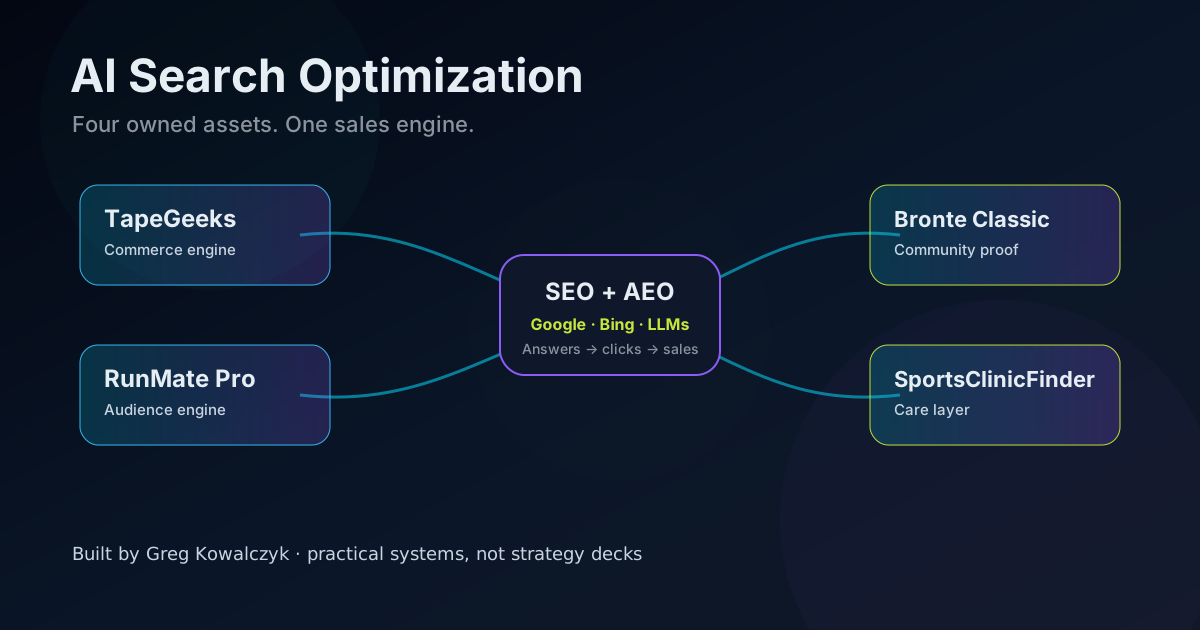
AI search optimization tools only matter if they help you ship better pages. For a small business, the best stack is a five-part loop: Google Search Console to find demand, an AI assistant (Claude, ChatGPT, or Gemini) to rewrite pages answer-first, a live-page check to verify the changes shipped, IndexNow to push changed URLs, and a weekly log so you learn what moved. I run that exact loop across TapeGeeks, RunMate Pro, Bronte Harbour Classic, and SportsClinicFinder.
Key takeaways:
- AI agents are already probing Google with full conversational prompts — and you can watch them do it in your own Search Console.
- Paid AEO platforms such as Profound and AthenaHQ are monitoring tools. They measure AI visibility; they do not create it.
- Fix your pages first with the free loop. Pay for monitoring once you have citations worth tracking.
- Every site (or page) needs exactly one job: sell, prove, teach, or route.
That is what AI search optimization means for a small business in 2026 — and TapeGeeks is where I test every change first, because it has the most search traffic of my four sites.
What AI search traffic looks like in Search Console
AI agents are already querying Google with full conversational prompts, and they show up in your own Search Console query report. According to my own Search Console data, this post drew 195 impressions in a single two-week window in August 2026, and most of them came from machine-generated prompts rather than humans.
The queries look nothing like classic keywords. They look like this:
“I’m a search manager at a large enterprise tasked with driving organic visibility. I want to optimize our content for AI-powered search results and secure exposure. What kind of customer support and training does [vendor] provide…”
Data from the same report shows the single most frequent query was a 45-word conversational prompt like that one, and it appeared 44 times in 60 days. Dozens of near-identical variants ran alongside it, each swapping in a different vendor question. These are AEO monitoring platforms and AI agents running live Google searches at scale, testing which pages surface for buyer-style prompts.
Two things follow from that:
- AI-mediated search is real and measurable, even on a small site. You do not need a paid dashboard to see it — the evidence is sitting in your free Search Console query report today.
- The prompts reward pages that read like direct answers. A conversational question can only be satisfied by a page that actually answers something. Vague category pages never surface for these queries; answer-first pages do.
That second point is the entire argument for the system on this page.
Do you need a paid AEO platform like Profound or AthenaHQ?
Most small businesses should not pay for an AEO platform until their pages already earn impressions worth defending. The tools are real and the category is growing fast, but it helps to be precise about what they do.
Profound’s published pricing lists a Starter tier at $99/month and Growth at $399/month, with enterprise plans custom-priced. AthenaHQ’s published plans include a free tier and a $295/month Starter aimed at self-guided small businesses, with enterprise pricing custom. Scrunch AI sits in the same category, positioned more toward agencies and multi-brand teams.
Here is the honest comparison:
| DIY loop (what I run) | Paid AEO platform (Profound, AthenaHQ, Scrunch) | |
|---|---|---|
| Monthly cost | ~$0 — GSC, IndexNow, and an AI assistant you likely already pay for | $99–$399/month published entry tiers |
| What it does | Fixes pages: answer-first copy, FAQs, entities, internal links, indexing | Monitors how AI engines mention and cite your brand |
| Creates citations? | Yes — this is the work itself | No — it measures results; you still have to fix the pages |
| Best fit | Sites still earning their first AI citations | Brands already cited, tracking share of voice across engines |
Best for: a small business whose pages are not yet quotable. The free loop is the work — no platform does it for you.
Not ideal for: teams already showing up in AI answers who need to track citation share across ChatGPT, Perplexity, Gemini, and AI Overviews at once. That is where a paid platform earns its fee.
Bottom line: fix your pages first; buy monitoring once there is something to monitor.
The four-site model I’m running today
Every site in my system has exactly one job, because a site without a job becomes another login and another maintenance problem.
Here is the system as of today:
| Site | Job | What it sells or supports |
|---|---|---|
| TapeGeeks | Commerce engine | Kinesiology tape, performance tape, mouth tape, adult nasal strips, kids nasal strips, wholesale clinic buyers |
| RunMate Pro | Audience engine | Free iPhone running app, GPS tracking, shoe mileage, routes, injury-prevention habits |
| Bronte Harbour Classic | Community proof engine | Father’s Day run/walk, Kids 1K, 5K, 10K, Oakville active lifestyle audience |
| SportsClinicFinder | Care layer | Physiotherapy, chiropractic, athletic therapy, sports medicine discovery |
The mistake most businesses make is pushing every searcher straight to a product page.
That is lazy.
If someone is searching for “best free running app for iPhone,” they do not need kinesiology tape first. They need RunMate Pro. If they are searching for “knee pain running,” maybe they need education, tape, shoe mileage tracking, or a physiotherapist. The job is to route them correctly.
That is where the system starts to work.
My AI SEO tool stack for small business
The practical stack costs almost nothing and covers five jobs: demand, verification, rewriting, discovery, and learning. The AI search optimization loop I run on TapeGeeks starts in Search Console, not in a paid dashboard.
| Job | Tool type | Why it matters |
|---|---|---|
| Find demand | Google Search Console | Shows pages and queries already getting impressions, which is where the fastest wins usually are. |
| Check live pages | Browser, crawler, or script | Confirms the title, opening answer, internal links, and page weight are actually live. |
| Rewrite faster | Claude, ChatGPT, Gemini, or another AI writing assistant | Speeds up title/meta/opening rewrites, but the human still owns the angle and proof. |
| Submit changes | IndexNow and sitemaps | Helps Bing and connected systems discover changed URLs faster. |
| Learn | Experiment log | Stops you from repeating the same tactic after the data says it failed. |
The point is not to collect tools. The point is to run the loop every week.
Why this matters for Google and AI answers
Classic SEO fundamentals still decide whether you get found at all: titles, meta descriptions, internal links, sitemaps, Search Console, Bing submissions, page speed, canonicals.
But AI search adds another requirement: your page has to be quotable.
A vague page is hard to cite. A clear answer block is easy to cite.
So I’m adding these patterns across the network:
- short “quick answer” sections near the top
- explicit entity names: TapeGeeks, RunMate Pro, Bronte Harbour Classic, SportsClinicFinder
- FAQ-style answers that stand alone without the surrounding page
- clear comparison tables
- internal links that match the buyer journey
- product links only when the searcher is ready for a product
- responsible care links when the problem needs a clinic, not a tape roll
That is the difference between “content” and an owned media sales system.
The TapeGeeks role: turn education into orders
TapeGeeks earns most of its search traffic through blog posts rather than product pages, and that tells me exactly what to fix.
The blog is doing its job: it earns attention. Now the commercial pages need to earn the next click.
TapeGeeks is the commerce engine, so it gets the AI search optimization work first:
- kinesiology tape pages
- performance tape pages
- bulk tape and wholesale clinic pages
- Breathe+ mouth tape
- adult nasal strips
- kids nasal strips
- blog-to-product internal links
- professional buyer language for physios, chiropractors, clinics, and athletic therapists
I’m not trying to make TapeGeeks sound like a medical site. That would be a mistake.
TapeGeeks should sound like what it is: a product and education brand built around active people, clinics, race-day support, and practical recovery tools.
The RunMate Pro role: earn the athlete before the sale
RunMate Pro is the audience engine: a free iPhone running app that earns trust before anyone is asked to buy anything.
A runner, walker, gym-goer, CrossFitter, or everyday athlete needs cardio. Running and walking are the simplest cardio tools most people can actually stick with. RunMate Pro gives them a free way to track the habit.
The app connects to the rest of the system because it solves problems before someone buys anything:
- GPS tracking
- shoe mileage tracking
- route history
- simple training records
- injury-prevention education
- privacy-first running data
That gives us a clean search path:
- Person searches for a free running app.
- They find RunMate Pro.
- They learn about shoe mileage, injury prevention, and training consistency.
- When they need tape, breathing support, or clinic help, we have the next step ready.
That is better than trying to sell tape to a cold visitor on the first click.
The Bronte Harbour Classic role: proof in the real world
The Bronte Harbour Classic gives the whole system real-world signals that Google and AI models can verify: a location, results, photos, sponsors, vendors, volunteers, and a clear annual story.
It is a Father’s Day run/walk and community event for runners, walkers, kids, gym-goers, CrossFitters, active families, and people who want a healthy cardio goal.
The 2026 inaugural race was a success. Now we are preparing 2027.
The next version is already a go:
- Kids 1K
- 5K
- 10K
- Father’s Day positioning
- Oakville / Bronte Harbour community
- active lifestyle, not elite-only racing
A real event makes TapeGeeks and RunMate Pro more credible because they are tied to an actual active-living community, not just product pages.
The SportsClinicFinder role: don’t pretend tape fixes everything
SportsClinicFinder exists because not every pain point belongs on a product page.
Tape is useful. Nasal strips are useful. Run tracking is useful.
But if someone has real pain, recurring pain, swelling, weakness, numbness, or an injury that changes how they move, they may need a physiotherapist, chiropractor, athletic therapist, or sports medicine clinic.
That is why SportsClinicFinder belongs in the ecosystem.
It lets us route serious clinic-intent searches responsibly instead of pretending every issue can be solved with a product.
That builds trust. It also expands search coverage.
What AI search optimization tools have to prove
Search Console is showing this page for long, specific questions about AI search optimization tools: support, training, integration, accuracy metrics, data privacy, and whether a platform can fit an existing workflow. That tells me the page needs a more practical buyer checklist.
For a small business, the best AI search optimization tool is the one that gets a real page changed, checked, and measured. A dashboard that says “visibility is down” is not enough. The work is finding the page-query mismatch, rewriting the first screen, submitting the changed URL, and checking whether clicks, rankings, or AI citations moved.
If I were choosing an AI search optimization tool for a small business, I would not start with the flashiest demo. I would ask six questions:
| Question | What a useful answer looks like |
|---|---|
| What customer support is included? | A real onboarding path, plain-English documentation, and a human escalation route when the tool affects revenue pages. |
| Can it integrate with the current stack? | It works with the website, analytics, CRM, product catalogue, or content workflow you already use instead of creating another isolated dashboard. |
| How does it measure accuracy? | It reports which pages, queries, citations, rankings, AI answers, and conversions changed after each recommendation. |
| How is privacy handled? | It explains what data is stored, who can access it, and whether your content or customer data trains the vendor’s model. |
| Can the workflow be customized? | It adapts to your brand voice, products, locations, compliance needs, and internal approval process. |
| Does it create work or finish work? | The best system finds the opportunity, drafts the fix, verifies the live page, submits the URL, and records the experiment. |
For a small business, that last line matters most. A tool that only produces suggestions still leaves the owner with the hard part: deciding, editing, shipping, and checking.
Support, training, integration, and privacy checklist
Before paying for any AI SEO or AEO platform, I would run this six-point check:
- Support: can someone explain why a recommendation was made, or are you left reading a score?
- Training: does the tool teach the team a repeatable workflow, or does one person become the only operator?
- Integration: can it work with your CMS, Shopify store, Search Console data, analytics, and internal docs?
- Accuracy: does it track before-and-after results by URL and query, not just a generic visibility score?
- Security: can you keep private customer, order, and business data out of model training?
- Control: can a human approve changes before they go live?
Here is the quick filter I use:
| If the tool mostly does this | Treat it as |
|---|---|
| Audits your current AI visibility | A monitoring tool |
| Shows which prompts mention competitors | A market-research tool |
| Drafts page fixes from real GSC data | A workflow tool |
| Publishes changes without human review | Too risky for most small businesses |
| Tracks before-and-after by page, query, and citation | Worth testing |
That is how I judge the category. Not by the logo list. Not by a synthetic score. By whether the system helps a business ship better pages without losing control of its data or voice.
The operating loop
The system only works if the loop runs every week, and the loop is boring on purpose.
Here is the loop I’m using now:
- Check Google Search Console and Bing signals.
- Find pages getting impressions but weak clicks.
- Improve the title, answer block, internal links, or commercial CTA.
- Add entity language so AI systems understand the relationships.
- Submit changed URLs through IndexNow.
- Verify the live page.
- Record what changed and what we expect to happen.
Every AI search optimization change on TapeGeeks gets logged: what changed, when it was submitted, and what we expected to happen.
That is the boring part. It is also the part most people skip.
Most AI search advice is too abstract. Mine is not. I’m making the changes, checking the pages, submitting URLs, and watching the data — including the machine-generated queries described above.
What I would copy first
If I were starting from zero I would not build four sites; I would build four page types and connect them.
- one page that sells
- one page that proves the business is real
- one page that teaches
- one page that routes the buyer to the next step
That is the whole system in simple form.
If you already have multiple assets — a product store, an app, an event, a directory, a YouTube channel, a newsletter — then the job is not “publish more.” The job is to make each asset do one job and link them in the order a real buyer moves.
That is what I am doing with TapeGeeks, RunMate Pro, Bronte Harbour Classic, and SportsClinicFinder.
FAQ
What are the best AI SEO tools for a small business?
The best AI SEO tools for a small business are Google Search Console for finding real demand, an AI assistant such as Claude or ChatGPT for answer-first rewrites, a browser or crawler for verifying live pages, IndexNow for fast discovery, and a simple experiment log. That free stack, run weekly, beats an unused paid dashboard for almost every small site.
Do small businesses need a paid AEO platform like Profound or AthenaHQ?
Not at first. Platforms like Profound and AthenaHQ mainly monitor how AI engines mention a brand — they measure visibility rather than create it. A small business gets more from fixing its own pages: answer-first copy, FAQs, clear entity names, and fast indexing. Paid monitoring starts to earn its fee once a brand already appears in AI answers and needs to track and defend those citations.
What is AI search optimization for small business?
AI search optimization is the work of making pages easy for search engines and AI answer tools to understand, summarize, and cite. It combines classic SEO with answer-first writing, self-contained FAQ answers, clear entity names, internal links, and visible proof. For a small business like TapeGeeks, AI search optimization mostly means rewriting existing pages so each section can be quoted on its own.
Is AEO different from SEO?
AEO is SEO with more pressure on clarity, not a separate discipline. A page still needs technical health, internal links, and rankings to be found at all. On top of that, it needs short, self-contained answers that an AI system can lift and quote accurately without the surrounding page. Sites that already rank usually need structural edits, not new content, to become citable.
How can you tell if AI systems are finding your website?
Open Google Search Console and read the full query report for each page. Machine-generated queries are easy to spot: long, first-person conversational prompts such as “I’m a search manager at a large enterprise…” mixed in with normal keywords. Those queries mean AI agents and monitoring tools are retrieving your page. Perplexity and ChatGPT can also be asked directly what they know about a brand.
Do small businesses need multiple websites?
No — multiple websites only help when each one has a distinct, necessary job. Most small businesses should start with one strong site built around four page types: a page that sells, a page that proves the business is real, a page that teaches, and a page that routes visitors to their next step. Add a second site only when a role truly cannot live on the first.
Why connect products, apps, events, and directories?
Real buyers do not move in a straight line: they search, compare, train, attend events, buy products, and sometimes need professional help. Connecting a store, an app, an event, and a directory lets each searcher land on the asset that matches their intent and then move one step closer to a purchase — or to a clinic when a product is the wrong answer.
What is the biggest risk with this approach?
Scattered execution is the biggest risk. Four weak sites are worse than one strong site, and ten half-finished optimization tactics are worse than one loop run every week. The system works only when every page has a job, every internal link has a reason, and the Search Console data gets reviewed on a schedule. Consistency beats tooling in every case I have measured.
Bottom line
I do not want websites that sit there.
I want websites that work.
TapeGeeks, RunMate Pro, Bronte Harbour Classic, and SportsClinicFinder are being wired into one connected AI search and sales machine. Not overnight. Not by guessing. By shipping pages, connecting intent, checking data, and improving the system every day.
That is the work.