Runner Safety Ecosystem: Building Beyond Race Day
A race is one morning a year. Sun safety, shoe wear, kinesiology tape, and clinic access are the runner safety ecosystem that covers the other 364 days.
This is Part 6 of Building a Digital-First Race — a series on the digital and AI decisions behind the Mercedes-Benz Oakville Bronte Harbour Classic 5K, and why we made them. Previously: why we archived every race forever, how AI organized 1,800+ race photos, why every sponsor and vendor gets a permanent page, why our medals carry QR codes, and how we built a race website that grows instead of starting over.
The race itself is one morning a year. This June 21 — Father’s Day — 875 runners sold out the start corral at Bronte Heritage Waterfront Park, and by early afternoon the festival had wound down and the waterfront was quiet again. Everything I’ve written in this series so far has been about that one morning: the archive, the photos, the medals, the site.
Somewhere around Week 4, a sponsor asked me a different question: what happens the other 364 days? That’s not a website problem, and it’s not something one app can answer honestly. My real answer turned out to be a runner safety ecosystem — four separate tools, built at different times for different reasons, that between them cover sun exposure, training load, in-race recovery, and what happens if something actually goes wrong.
Quick Answer: Our runner safety ecosystem is four independent tools, not one app: SunUp (personalized UV and air-quality forecasting), RunMate Pro (GPS tracking plus shoe-mileage wear alerts), TapeGeeks (kinesiology tape and recovery, on-site at BHC), and SportClinicFinder.com (12,770 Canadian sports-medicine clinics). Each covers one part of staying injury-free outside race day.
The gap a single race can’t close
Race-day safety is a solved problem, more or less. A medical tent, water stations, a course marshalled at every turn — that’s a checklist, and any organized 5K gets it right. What a single morning can’t touch is the eight weeks of training before it, where most running injuries actually happen, or the sun exposure at an all-day outdoor festival that runs well past the 8:30 AM gun.
A systematic review by van Gent et al. in the British Journal of Sports Medicine put running-related injury incidence at 19–79% per year among recreational runners, depending on training load — overwhelmingly overuse injuries to the knee, lower leg, and foot. None of that shows up on a race-day medical log, because it happens weeks before the runner ever gets to the start line.
So instead of treating safety as something the race provides for four hours, I’ve spent the last two years building tools that treat it as a year-round problem. None of them were built for Bronte Harbour Classic specifically — they came out of GearTOP and TapeGeeks, the two e-commerce brands I run — but the race is where they meet the people who need them.
Before you run: the sun problem nobody checks
Oakville’s UV Index regularly hits 7–9 in late June, and at UV Index 8 a fair-skinned adult can start burning in 10–15 minutes unprotected — even through cloud cover, which blocks less UV than people assume. Almost nobody checks this before they walk out the door, because the number that matters (personal burn time, not just “the UV index”) isn’t something a weather app gives you.
SunUp, built by GearTOP, takes skin type, live UV, cloud cover, and time of day and returns one number: minutes until you burn. It also does family mode, because my kid’s safe exposure time is not mine, and it surfaces air quality — which matters more than runners think on a warm, stagnant day when ground-level ozone spikes. It’s free on iOS, and it’s the tool I’d put first in this ecosystem, because sun exposure is the one variable that affects every runner and every spectator at an outdoor event, not just the ones already managing an injury.
While you train: the two numbers that predict overuse injury
Most running shoes last 500–800 km before the midsole foam compresses and stops absorbing impact. The shoe looks fine. The cushioning that protects your joints is quietly gone. Research in the British Journal of Sports Medicine links that compression directly to increased lower-limb injury risk, and almost nobody tracks it — they buy a pair, run in it for a year, and wonder why their knee started hurting in March.
RunMate Pro exists to close that gap: GPS tracking, route history, and shoe mileage assigned per pair, so you get a concrete number instead of a guess. When mileage on a pair climbs past 500 km, that’s the signal to start planning a replacement, not wait for pain to tell you.
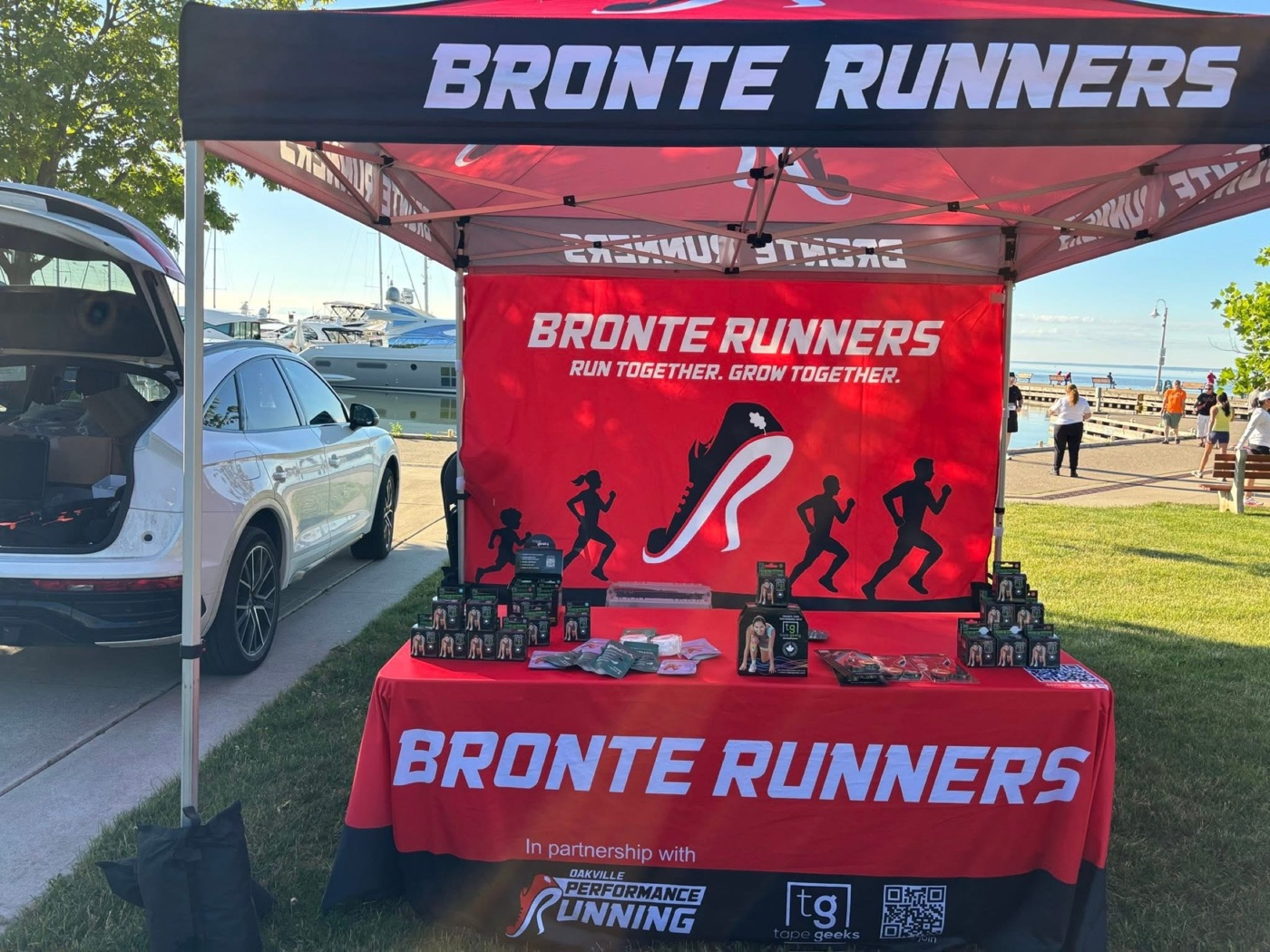
The second number is what to do about the soreness that shows up before you replace anything. A 2017 systematic review in Physical Therapy in Sport found meaningful pain reductions from kinesiology taping across common lower-limb running conditions. TapeGeeks, which I co-founded, is the Tape & Recovery Partner at Bronte Harbour Classic — a free taping station runs before both race-morning starts — and the underlying product line (kinesiology tape, rigid tape, and the Breathe+ nasal-strip and mouth-tape line) is built around exactly this: extending training tolerance so a nagging IT band or shin doesn’t turn into eight weeks off.
If something does go wrong: closing the loop
Prevention fails sometimes, and when it does, the next problem is purely logistical: who treats this, and are they any good? In Canada that’s a surprisingly hard question to answer quickly — physiotherapy and sports-medicine clinics are scattered across provincial registries, Google listings, and clinic websites of wildly varying quality.
SportClinicFinder.com is a directory of 12,770 active clinics across 521 cities — every Canadian province and territory — searchable by city, injury type, or specialty, with insurance details and booking links where they exist. It’s the piece of the ecosystem that isn’t about Bronte Harbour Classic at all; it’s a national resource that happens to answer the question a runner in Oakville, or anywhere else in the country, asks the day something actually hurts.
Why a runner safety ecosystem means four products, not one app
The obvious critique of this whole setup is that I should have built one app instead of four. I’ve thought about it, and I don’t think it’s the right call, for a specific reason: each of these tools has its own business reason to exist, independent of the others.
SunUp sells GearTOP’s sun-protection products. TapeGeeks sells tape and recovery gear. SportClinicFinder.com earns from clinics that claim their listing. RunMate Pro is the one exception — genuinely free, no monetization — but it survives because it’s small, focused, and cheap to run, not because it’s subsidized by the others. If Bronte Harbour Classic disappeared tomorrow, all four would keep working for the people who use them. A single bundled “Runner Safety” app would have none of that independent gravity, and in my experience, a feature bolted onto a product nobody asked for gets used a lot less than a product built because the underlying need was already real.
What actually ties the four together isn’t a shared codebase — it’s a shared build method. I’m a mechanical engineer with 22 years in industrial equipment design, not a software developer. Every one of these was built with AI doing the implementation work while I specified the logic: SunUp and RunMate Pro through React Native and Claude Code, SportClinicFinder.com’s enrichment pipeline the same way. That’s the actual thread running through this whole series — not one app, but one repeatable way of turning a specific, real problem into a shipped tool without hiring a development team first.
The honest limitation
I don’t have a controlled study showing that BHC runners get injured less often because these four tools exist. That would require tracking outcomes across products that deliberately don’t share a database, and I haven’t built that measurement layer — it may not be worth building, given how small a single race’s runner population is against any of these tools’ actual user bases. What I can point to is adoption in the group I actually see every week: Bronte Runners members who now check SunUp before a summer group run, who show up at the TapeGeeks table with a specific ache rather than waiting for it to worsen, and who mention their shoe mileage unprompted because RunMate Pro put a number in front of them. That’s observed behavior, not a clinical result, and I’d rather say that plainly than imply more than the data supports.
What this means if you organize anything with a training component
If you run a race, a fitness challenge, or any event with a training arc leading up to it, the takeaway isn’t “build four apps.” It’s this: safety at your event and safety in the training that leads to it are different problems, and most organizers only solve the first one. The tools that solve the second don’t need to be yours — they need to exist, be free or cheap enough that people actually use them, and be something you can point your participants to without embarrassment. Start with whichever gap is worst for your specific crowd. For us, that was sun exposure and shoe wear, because we’re a summer race with a lot of first-time 5K runners. Yours might be hydration, or heat acclimatization, or something else entirely — but the fix is almost never “add a feature to the event website.”
FAQ
What is a runner safety ecosystem?
A runner safety ecosystem is a set of independent tools that each cover one part of staying injury-free around a race, rather than one app trying to do everything. Ours is four: SunUp for UV and air-quality exposure, RunMate Pro for training load and shoe wear, TapeGeeks for taping and recovery, and SportClinicFinder.com for finding treatment if an injury does happen. Each solves a real problem on its own.
Do SunUp, RunMate Pro, TapeGeeks, and SportClinicFinder share data with each other?
No, and that is deliberate. Each tool has its own business reason to exist and its own database. The trade-off is real — I cannot query across all four to prove the ecosystem reduces injuries. What connects them is documentation and cross-linking: RunMate Pro’s in-app guide points to TapeGeeks techniques, and this article is the map that ties all four together for anyone trying to follow the same thread.
Are these tools actually free to use?
SunUp and RunMate Pro are both free on iOS, no subscription or account required. SportClinicFinder.com is a free public directory, and clinics pay only if they want to claim and enhance their own listing. TapeGeeks is a retail brand — the products cost money, but the taping station at Bronte Harbour Classic race day is free.
Do I need all four tools, or should I just pick one?
Pick whichever solves the problem you actually have. If you are training through a hot summer, start with SunUp. If you do not know your shoe mileage, start with RunMate Pro. If something already hurts, TapeGeeks or a clinic from SportClinicFinder.com is the more useful stop. Very few runners need all four running at once — most need one, at the right moment in their training.
Next in the series: Why Every Outdoor Race Needs a Sun-Safety Plan (Most Don’t Have One) — the first of four deeper looks at each piece of this ecosystem, starting with sun exposure.
The runner-facing version of this story is on the race site: Staying Safe Running Outside in Oakville: Beyond Race Day. And if you want the build details behind any of these four: SunUp, RunMate Pro, SportClinicFinder, and the Bronte Harbour Classic site itself.
Directing a race or running a community event? I help race directors build this same system.